One of the many reasons why Star Wars has endured is because George Lucas’ cinematic space saga has portrayed burgeoning adolescence with touching sincerity and universality. As the Disney era has worn on, the spirit of this mantra has lingered with the roman numeral instalments. However, the spin-off films have represented a new schism for this paradigm; namely, the tension between making essential stories in a universe that generations of moviegoers are so accustomed to seeing in a particular way.
Disney’s second attempt at indulging in the galactic sandbox has carried enough weight to pull down the ears of a Gundark. Famed comedic and computer animated directing duo, Phil Lord and Chris Miller were let go in the midst of principal photography, and Ron Howard was brought in to turn a troubled mess into a finished film. Like its title character, this second stand-alone feature smiles with the ease of an endeavour that feels like it has shaken off its burdensome production woes. In fact, in its best moments, it has the brash confidence of a rousing adventure picture of yore. But its broad wry gesture cannot extinguish a paramount problem that lies at the heart of the movie and significantly undermines it at every turn.
Solo: A Star Wars Story depicts the early years of Han Solo (Alden Ehrenreich) as the budding famed pilot and smuggler attempts to return to his impoverished homeworld (Corellia) to release his loving girlfriend- Qi’ra (Emilia Clarke) from a life of crime. Along the way, he meets his famed Wookiee co-pilot, Chewbacca (Joonas Suotamo), his debonair long-standing friend, Lando Calrissian (Donald Glover) and Tobias Beckett (Woody Harrelson). Beckett is the man who comes to cement much of the character’s cynicism in the original Star Wars and functions as an entry point for the criminal underworld. Together, Solo and Beckett pull of a series of daring heists in the hopes of being rid of a terrible price on their heads and freedom to live a normal life.
Conceptually, Solo: A Star Wars Story is a fascinating inversion of the burgeoning adolescence theme of the saga. In stark contrast to the journeys of Luke and Rey that had parental strife, which resulted in a newfound faith and self-actualisation. The 2018 film attempts to depict how Han’s tumultuous early experiences of the world via a surrogate family shaped his lack of faith and self-interest instinct. Unfortunately, in execution, the theme has no emotional resonance due to a deficient central performance.
Alden Ehrenreich plays the younger incarnation of the character as though he is in a comedic sketch that is hyperbolically riffing on Solo’s worst qualities. Starting at smug and ending at cheeky, Ehrenreich never convincingly portrays any sense that Han has been affected by the events of the film. It is a performance that lacks sincerity, internal strife and most importantly humanity.
The film is also somewhat marred by an unexpected sense of pacing that comes from the screenwriters jettisoning Han’s early years at the Imperial Academy in favour of narrative propulsion. The choice does mean some of the following scenes have hollowness as we are told Han got kicked out of the Empire training programme as opposed to seeing how and why he was let go. Moreover, the picture suffers from a whirlwind of third act double-crossings that make more sense at the moment then upon reflection. More crucially, Solo becomes entirely overshadowed by the supporting cast.
Emilia Clarke plays the noir-inspired Qi’ra in a counter-intuitive manner by putting on the front of a sunny and eternally hopeful young girl that hides the woman who has become a duplicitous and morally shady minion of the underworld. Donald Glover adds a dimension of ego and empathy to a younger Lando Calrissian without forgetting the inherent smoothness of the character. And Phoebe Waller-Bridge steals the show as a socially conscious droid called L3-37, whose demented physical gestures and whetted line deliveries prove that droids continue to be the secret weapon of the franchise.
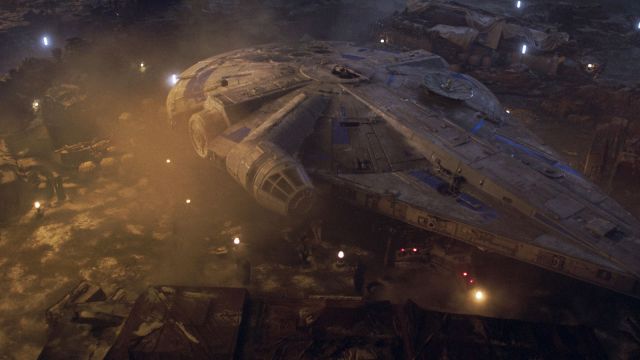
Solo: A Star Wars Story is at its best as an exercise in world building. The film creates a rich and sumptuous new corner of the universe that made me want to linger for hours on end. Cinematographer Bradford Young composes a majority of the shots with an eye towards natural light. Consequently, a lot of the scenes are fundamentally dark but are lit by lamps and gauzes that create an interesting juxtaposition between the elegance of the surroundings and the seedy nature of the characters. The lighting choice also visually punctuates the saga’s persistent battle between the light and dark in a vivid new way.
Ron Howard’s staple as a director is taking contemporary stories and imbuing them with a mythical grandeur. Frost/Nixon framed the famous televisual debate between the two real-world figures as a David and Goliath story. Rush made a Formula One rivalry of a hotheaded speed demon and socially aloof, calculated engineer resonate with the import of a tale from Greek Mythology.
In Solo, Howard applies this same directorial trademark to interesting and subtle effect. Through persistent uses of long and low angle shots, Howard makes Chewie and Han’s first encounter seem like Theseus is entering the labyrinth to fight the Minotaur. In collaboration with Young, Howard also makes seemingly throwaway moments into instances of memorable imagery. The end of one scene illustrates how the hissing flames of a campfire combined with the close-ups of Han’s famous DL-44 heavy blaster pistol underscore its eventual use.
With moments that are bawdy and salacious, Solo’s portrait of the underworld owes a debt to David Lynch’s Dune as much as the midnight movies of the seventies and eighties. At the same time, the filmmakers also understand Star Wars’ cinematic heritage and heed to it admirably. The third act on Savareen plays like a greatest hit package of Sergio Leone Westerns; complete with cowboy shots, mundane objects becoming a soundscape of boiling tension and a narrative twist that makes the amorality of the main characters seem insignificant compared with the wave of an ongoing war. And John Williams’ Han Solo theme embodies the retro heroic spirit of the serials that inspired the space saga.
In the first fifteen minutes, there is a recurring visual motif of characters attempting to jump-start vehicles via flashy blue strips of wire. Solo: A Star Wars Story has a seductive visual flair that makes it wholly unique, but it’s a shame that the title character does not feel as interesting as his surroundings. This is not the young Han Solo I was looking for.






 SGS On Film