Review: The Last of Us Episode 1: When You’re Lost in Darkness

Preamble

To me, The Last of Us is akin to being the Casablanca of video games insofar as being a much beloved and weighty experience. It also defines and becomes synonymous with an era in a medium’s history (much like Casablanca has become a movie that springs to mind when someone says the Golden Age of Hollywood). The 2013 video game was certainly a paradigm shift for the medium, proving that it can tell gripping, emotive tales that are thematically rich and worthy of being called art.

It’s funny thinking back that I was rather mixed on The Last of Us on my first playthrough. I don’t know if I had become jaded by the zombie sub-genre or the weight of expectation that the game carried with it, but my arms were somewhat crossed throughout. I certainly enjoyed the gameplay loop that stuck an excellent balance of stealth, action and environmental storytelling (via problem-solving) etc.

Without going too much into it, I thoroughly loved Part 2. Its scope, ambition, themes and how it used the controller to make the player complicit in some of Ellie’s heinous acts stuck with me. On a subsequent playthrough via the PS5 remake, Part 1 resonated with me a lot more, with themes and emotions bubbling to the surface with greater clarity.

And now we come to the HBO adaptation of The Last of Us. There is something somewhat ironic and meta about the fact that many reviews of the game have cited it as HBO esque series in its scope and ambition. So, to now see it being adapted to something it was held up against just amuses me to no end.

But before I get to my thoughts on the first episode, let me address the big elephant in the room. As the name of my blog implies, it’s dedicated to discussion and reviews of films etc. However, I have tackled Twin Peaks in the past (through the prism of Fire Walk With Me and some episodes of Season 3) and The Mandalorian. Both those properties had roots in cinema, be it David Lynch’s cinematic prequel or Mando’s first episode being screened at select UK cinemas.

The Last of Us is arguably my first full dip into the waters of television. With this in mind, the reason why I’m asking you all to indulge me is that I want these to be like entries in a diary (much like blogging can be) as I tackle an acclaimed game being adapted to another medium. I think it will be an interesting challenge and a nice change to my other writings. At the same time, my experience with these games has been quite profound and private. Due to reviewing the series, I’m taking myself out of the general noise of the discourse (not watching various breakdowns and reviews etc) and instead focusing on my thoughts on each instalment of the show. So, I hope you join me as I intend to be back here every Monday evening with my thoughts on the latest episode from HBO’s The Last of Us series.

And finally, if you liked my ramblings here, then you can find more at my second home, Horror Obsessive. One of my most recent pieces was about the subtext of the recent Resident Evil game, Village. https://horrorobsessive.com/2022/09/10/a-village-of-abuse-the-subtext-of-resident-evil-8/

Have you seen the first episode of The Last of Us? And have you had any prior experience with the video game? Let me know in the comments below.

Review

By the end of the first episode of The Last of Us, I was reminded of a simple and effective quote from Doctor Who’s 50th-anniversary episode, “The Day of the Doctor.” At the end of that episode, after reflecting on what he dreams about, the Doctor says, “Home. The long way round.” Much like the Zack Synder-directed Watchmen movie and the Damon Lindelof-penned Watchmen series, The Last of Us pilot carries the convictions of its source material but goes about setting up its themes in fascinating new ways.

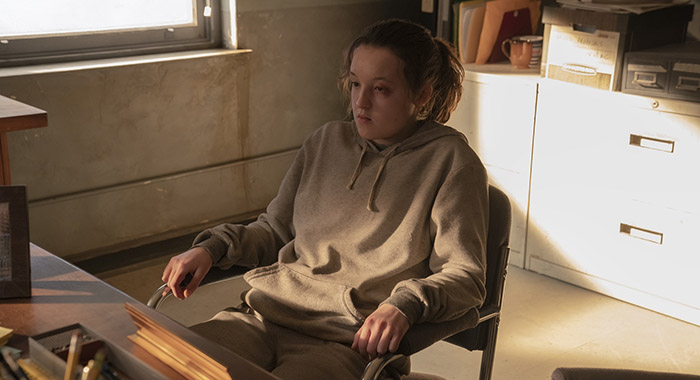
After a lengthy and tense opening, which has a scientist outline how the human race can be brought to its knees via a fungal virus: the first episode of the HBO series introduces us to Joel Miller (Pedro Pascal), his brother, Tommy (Gabriel Luna) and daughter, Sarah (Nico Parker). Amid the backdrop of a fungal virus, the family unit befalls a devastating tragedy. 20 years later, Joel is working various jobs in a Boston quarantine zone and is trying to contact his brother. He is joined in his search by his frequent smuggling partner, Tess (Anna Torv). However, life becomes complicated for the pair when the leader of an insurgent group (The Fireflies), Marlene (Merle Dandridge), tasks them with transporting a 14-year-old girl, Ellie (Bella Ramsey).

The appeal of the pilot episode is from its dance between faithfulness to the source material and inversion of what we know. The best example is Sarah’s point of view. In the game, we get a brief sense of her relationship with Joel before the action starts. However, here, we get more scenes as the structure is a day in her life.

These scenes where Sarah acts as someone who is almost a parental figure to a dozy Joel are a sweet reminder of how kids are as important in providing a sense of calm and rationality in our everyday chaotic existence.

At the same time, the filmmaking in these sections is quite subtle and impressive. There are a few locked down shots, which occasionally obscure the background. They go a long way in emphasizing tension and the subtle instances of Sarah missing allusions to the brewing horror of the pandemic. Sarah’s perspective is also crucial for the introduction of a theme that could permeate the entire series.

After finding her elderly neighbour in a zombified state, Sarah runs outside and is met by her father and uncle. She’s horrified to see Joel killing the undead creature. At once, it points to the game’s theme of the lengths we’re willing to go to protect our loved ones. But it also points to how we can lose our humanity in the pursuit of violence (even in a justified situation). Later on, there’s almost a direct mirroring of the tragic circumstances surrounding Sarah (this time involving Tess and Ellie). I found this scene to be the episode’s most promising moment. It’s a reinforcement of the shocking lengths you’re willing to go to protect your loved ones. But it also could be read as a cycle of violence that’s inherently primal and keeps repeating (particularly in this climate). The moment could sow the seeds for some of the themes that spoke to me with Part 2.

While Pedro Pascal has been famed for playing quite paternal roles in the past, he casts an impression as Joel. His initial goofiness and subsequent cynicism (portrayed in fleeting gestures) are striking in illustrating a man who is broken and frozen in time. From the trailers, I had my doubts about Bella Ramsey as Ellie. However, she gives an impressive performance, portraying the fierceness and intelligence that made the character such an indelible presence in the first game. In her reprisal of Marlene, I appreciated Merle Dandridge’s sardonic and almost menacing turn as the leader of the Fireflies.

It sounds odd to say, but the show’s worldbuilding via elaborate set design and frequent bustling activity with slow panning camera moves gave me a better sense of the world than the video game. Part of this comes from the perspective being broader and the details being more sketched in. Also, moments such as Joel throwing a child’s dead body in a fire go a long way in portraying the downtrodden and hopelessness of a post-pandemic Boston.

Overall, the pilot episode is a solid start to The Last of Us series. While it’s undoubtably faithful to the source material, it uses its medium to plant interesting themes and motifs that could permeate the series. Much like the quote from the Doctor, it appears so far to be getting to the heart of the video game in its own unique way.

Posted in 2023, Review, Reviews | Tagged , , , , , , , , , | Leave a comment

Review: True Lies (1994)

Preamble

I don’t know if it’s a product of getting older or the fact that it’s a start of a new year, but I’ve been fondly looking back at the cinema from the era I grew up in (aka the 90s). To me, it’s the time when the medium seemed larger than life and wonderous in the images and situations they depicted. However, many of the action movies from this era exist in my mind as singular moments scattered across an ocean of cinematic experiences. This year, I will attempt to remedy that by watching and reviewing some 90s action movies. The first on my list is True Lies, which on the surface seems like an interesting outlier in James Cameron’s filmography insofar as between sandwiched between the technologically influential Terminator 2 and box office behemoth, Titanic. Have you seen the 1994 movie? Let me know in the comments below.

Review

James Cameron’s action moves have always had fascinating contradictions. On the surface, Aliens seems like a pro-military and gun movie, but also has a maternal spirit and empathy coursing through its veins. Terminator 2 is about two machines who relentlessly kill. However, the most robotic and machine-like character turns out to be a militant Sarah Conner, juxtaposed with the T-800, who learns to be an empathetic surrogate father figure to a young John Conner. Within this tightrope walk between militant and primal emotions, True Lies is a fun and captivating movie. It’s essentially a perfectly pitched Schwarzenegger action movie with a beating heart of domesticity and martial disenchantment.

Cameron’s fourth movie tells the story of Harry Tasker (Arnold Schwarzenegger), who unbeknownst to his wife, Helen (Jamie Lee Curtis) has been a secret agent for the Omega Sector, which specializes in counterterrorism. Life becomes complicated for Harry when he suspects his wife of having an affair. The paranoia leads to a chain of events that will forever change Harry’s marriage as his personal and work life collides with one another.

Part of the appeal of True Lies comes from its tantalizing premise of what if Arnie the action star had a semblance of internal life. While some of Arnie’s previous movies have had his character attempting to protect loved ones, they’ve often felt like plot devices for motivation as opposed to independent characters with agency. One of True Lies’s few awkward steps comes from Harry’s daughter, Dana Tasker (Eliza Dushku) being relegated to a plot device (with the thread about her stealing being set up and not addressed again).

This aspect is coupled with the movie being an unabashed romantic and heightened spy movie. Cameron’s portrayal of the spy world is post-James Bond in the best way with time-wasting and seductive tangos along with amusing action situations. The highlight is a chase between Harry on a horse and the central terrorist figure, Salim Abu Aziz (Art Malik) on a motorbike (within the confines of a hotel).

At the same time, Cameron has fun with the spy concept insofar as installing it with a universality via many of the characters having a fake it until you make it confidence, that makes them able to play the part well. A recurring joke with many of the people that Jack greets asking “Who was that” along with Simon’s (Bill Paxton) sleazy car salesman illustrates this quality well. The juxtaposition between Simon’s and Jack’s confidence, indulging in the part of being an undercover agent shows Cameron attempting to blur the line between the spy and the sleek salesman.

But the true masterstroke of True Lies comes from how the spy adventure affects Helen. Curtis’s portrayal of a mousy and bored suburban woman, who has to discover her confidence and sexuality amid a mission is the lynchpin for Lies not becoming a post-modern Bondian affair. It also helps that Curtis equals Arnie in the delivery of one-liners (often with a sardonic and sharp edge). In particular, her line delivery of “I married Rambo!” is as funny in its post-modern implications as they are in a wife realizing she’s married to an action star.

Arnie is serviceable as a spy who is trying to lead a double life. He comes alive when he’s angry or has to portray action convincingly. However, much of the heavy lifting of making him a credible presence comes from the supporting cast. In particular, Tom Arnold’s Gib goes a long way in his world-weary cynicism and humour to make Arnie’s Jack a loose and fun spy.

If there’s a metaphor for how Cameron uses the Austrian action star then it comes in the scene with him and Curtis in a hotel room. Jack is dimly lit as he watches Helen strip and dances seductively in a series of medium shots. Aside from astounding Jack in seeing his wife in a new light, the scene also casts a shadow on Arnie and instead puts the spotlight on Jamie Lee Curtis’s embrace of her sexuality and spy part. It’s an encapsulation for True Lies not only being a more human showcase of the Arnie action persona but a humbling one too.

Posted in Uncategorized | Tagged , , , , , , | Leave a comment

My Top Ten Most Anticipated Films of 2023

Preamble

Happy New Year everyone. I hope you all have a wonderful 2023 that’s full of happiness, success and good times. Much like my last post in 2022, writing a top ten most anticipated films list feels like a return to some form of stability (since the pandemic), as release schedules hold firm and the cinematic cycles carry on cranking. The entire thing fills me with a giddy excitement as we can collectively dream and look forward to another year in moves. What are some of your most most hyped releases of 2023? Let me know in the comments below.

10) Salem’s Lot

Salem’s Lot is my favourite Stephen King novel. Despite thinking that the story would be best served in a long format television series, I’d be lying if I’m not curious about how it’s adapted for the silver screen.

9) Renfield

While Renfield immediately grabs my attention with Nicolas Cage playing Dracula, I do think that there’s some potential for focusing on the title character. This combined with the prospect of the movie being a comedic spin on Renfield’s time with Dracula, and we have something that’s conceptually intriguing.

8) Ant-Man and the Wasp: Quantumania

The Ant-Man movies have always felt like light interludes between the giant event-shattering movies in the Marvel Cinematic Universe (MCU). It comes as something of a surprise that Ant-Man’s second sequel will be a foundational movie in introducing Phase 5’s overarching antagonist and perhaps narrative. I look forward to seeing if this typical intimate corner of the MCU is successful in leaping to a full-blown cosmic crisis (insofar as stakes are concerned).

7) John Wick Chapter 4

On paper, it sounds like the match of the century, Pennywise vs Neo. Keanu Reeves vs Bill Skarsgard. To quote the late Stan Lee, “Nuff said…”

6) Mission: Impossible Dead Reckoning Part 1

The Mission Impossible movies have been very deft at balancing excellent action set pieces (via Tom Cruise’s penchant for doing death-defying stunts with a boyish enthusiasm) and exceptional spy intrigue. I’m curious about the balance between these elements throughout a two-part story.

5) Babylon

A movie about old Hollywood, its excesses and directed by Damien Chazelle. Colour me interested…  

4) The Fabelmans

On paper, an effort about the director putting his past on film seems like a self indulgence of the highest order. But if there’s one director who has earned the right to self-reflect via cinema then it’s Steven Spielberg.

3) Indiana Jones and the Dial of Destiny

Despite the absence of Spielberg in the directing chair, The Dial of Destiny fascinates me as a movie that could explore the sun setting on an iconic movie hero that’s collectively been with us for multiple generations.

2) Oppenheimer

It’s a testament to the teasers so far that Oppenheimer is not striking me as typical bio pic. Instead, I reckon much like Dunkirk, Christopher Nolan will deliver a towering experiential vision that only the cinema can deliver.

1) Dune Part 2

I’m very hyped for Dune Part 2. I’m excited to see Denis Villeneuve tackle the material from the book that’s arguably far stranger and difficult to adapt. At the same time, it will be a treat to see this part of the book that’s been previously confined to a seemingly elongated and rushed montage in David Lynch’s 1984 film.

Posted in Uncategorized | Tagged , , , , , , , , | Leave a comment

My Top Ten Films of 2022

Preamble

Not to damn 2022 with faint praise, but since the pandemic started in March 2020, it has felt like the year when things have returned to relative normalcy. As far as my movie watching is concerned, it has increased tenfold, with cinema trips being more frequent and appreciated since Covid began. With that in mind, I feel much more confident in sharing a bona fide top ten, (unlike previous years) complete with last-minute choices and hand-wringing about placements. What were some of your favourite movies in 2022? Let me know in the comments below.

10) Avatar: The Way of Water

The Way of Water is a beautiful and moving piece of blockbuster cinema that plays like a greatest hit completion of themes and motifs that have permeated James Cameron’s movies.

9) The Northman

With a larger canvas within a new genre, The Northman is a roaring and potent revenge parable about the dehumanising effect of myth.

8) Glass Onion: A Knives Out Mystery

Glass Onion plays like a potent social parable that unravels within the confines of the murder mystery genre.

7) Nope

Nope represents Jordan Peele’s most ambitious horror film to date. It’s expansive, intimate, occasionally harrowing, and subtextually fascinating in how it depicts two distinct ways in which horror movies are made.

6) Is That Black Enough for You?!?

Is that Black Enough for You is a potent lightning rod for Elvis Mitchell’s exploration of black cinema. Part love letter to the sub-genre and part critical essay for the depiction of African Americans, Mitchell’s documentary is ambitious and powerful in its message about black representation.

5) Crimes of the Future

David Cronenberg’s return to the sub-genre of body horror is an exacting and patient exercise in moviemaking. Future’s real power comes from being a snapshot of an evolution that feels credible and crude. In an era where the projection of our image is essential, Future asks us to consider how exhibitionism, body modification and voyeurism are not only given aspects of the human condition but perhaps even primordial.

4) Top Gun: Maverick

Top Gun: Maverick is a fascinating counterpoint to the 1986 movie. In fact, it’s quite an exhilarating, deeply moving and ultimately humbling sequel.

3) Halloween Ends

Halloween Ends worked for me. It’s audacious, ambitious, and comes the closest to the original 1978 film insofar as feeling like a potent horror fable.

2) Everything Everywhere All At Once

Everything Everywhere All at Once resets the canvas for Multiverse stories by showing how subversive, metatextual, emotional and bizarre the concept can truly be.

1) See How They Run

As I alluded to in my Glass Onion review, See How They Run has thawed my lifelong apathy towards the murder mystery genre. During my first viewing, Run charmed me with its acidic viewpoint of the genre via Leo Köpernick’s (Adrian Brody) cynical film director. In this regard, I was reminded of Brian De Palma’s gonzo and poisoned letter to the music industry (by way of Phantom of the Opera and The Portrait of Dorian Gray).

However, on a second viewing, I realised how Run also has affection for the genre via Constable Stalker (Saoirse Ronan). In isolation, this tightrope of celebration and denigration is impressive. However, I loved the film due to its main theme. Above all, See How They Run is about how the creator should not be beholden to the genre conventions or truth of source material. Embellishment is an artistic freedom that every writer should have.

Posted in 2022, 2022 Films | Tagged , , , , , , , , , | Leave a comment

Brief Consideration: Black Panther: Wakanda Forever (2022)

Preamble

Well, it’s that time of year again when you feel like you’re on a fast-track mine cart ride through the Christmas season and the subsequent end-of-the-year period. As a result, there’s almost this mad scramble to catch as many movies before compiling the invertible top ten movies of the year list. It’s with this context in mind that I made a mad dash to my local cinema, trying to find a sole screening amid the general explosion of The Way of Water screenings. But personal and meandering stories aside, have you seen Black Panther: Wakanda Forever? If so, what did you think of it? Let me know in the comments below.

Brief Consideration

By its title alone, Black Panther: Wakanda Forever suggests a tension between the titular hero and the empathic eternal existence of the nation they protect. It’s a problem that seems deeply embedded within the film itself. The 30th movie in the Marvel Cinematic Universe (MCU) has a lot on its mind. It’s working overtime as a tribute to the late Chadwick Bosman who immortalized the T’Challa iteration of the titular hero and continued exploration of Wakanda’s role as an affluent African nation with a desirable resource. The result is a messy, baggy and overlong effort that finds some emotive footing in its fleeting moments.

One such is at the tail end of the film where Shuri (Letitia Wright) partakes in a ceremony where she gets to finally mourn for her brother. With its subdued sunlight and almost flickering use of medium shots, the scene plays like a Terrance Malik scene of nature, which attempts to calm the soul of the new Black Panther. But for every elegant camera move or exceptionably staged action sequence (most notably the final three-pronged conflict that’s edited to a crescendo in a manner befitting the title of the movie), there’s a clumsy moment of filmmaking. The most egregious being a 360 degrees shot that wears out its welcome.

Crucially, the isolative spirit and powerful Afrofuturism themes that fueled the original film get lost in the shuffle. Instead, they’re replaced with a sense of a movie attempting to find its identity amid creaky plot machinations and points that don’t feel as engaging. This is a shame because as a tribute to the legacy of Chadwick Bosman, Wakanda Forever soars.

Posted in 2022, 2022 Films | Tagged , , , , , , , , , | Leave a comment

Review: Avatar: The Way of Water (2022)

Preamble

This is honestly one of the hardest preambles I’ve ever had to write. It’s not due to a crippling sense of writer’s block or fretting about how to frame the discussion. Waiting for The Way of Water has been a bittersweet experience. While there’s a sheer sense of anticipation and curiosity at what drew James Cameron back to Pandora, there’s also a sobering truth to acknowledge. In 2015, the esteemed film composer, James Horner died in a plane crash. His film scores that ranged from Star Trek III: The Search for Spock to The Karate Kid remake have been indelible and so stunning in their beauty. It truly is music that reaches deep down into your soul. And the prospect of a Horner-less Avatar score has been hard to bear at times.

With this in mind, it feels only right to dedicate this blog post to him. I miss you Mr Horner. The film music world is truly lesser without you. What’s your favourite James Horner score? Have you seen Avatar: The Way of Water? Let me know in the comments below.

Review

Avatar has been on a fascinating journey since it came out in 2009. Initially heralded as a cinematic experience that was likened to Star Wars (1977), the film has gone on to be mocked for its cliched melding of Dances of Wolves and Pocahontas. It now enjoys life as an odd curiosity that’s better than people remember. Not bad for an endeavour that’s enjoyed the title of the highest-grossing movie of all time for a great long while, and the chief reason why the 3D format became popular during the early 2010s. I still happen to think that it engages as a sweeping exercise in spectacle, with some of James Cameron’s best filmmaking (particularly evident in the physical media exclusive, Collector’s Extended Cut).

By comparison, The Way of Water is a beautiful and moving piece of blockbuster cinema, that plays like a greatest hit completion of themes and motifs that have permeated James Cameron’s movies.

Taking place ten years after the events of the first film, The Way of Water is about Jake Sully (Sam Worthington) balancing duties as the chief of the Omaticaya tribe, husband of Neytiri (Zoe Saldaña) and father of four kids. However, trouble emerges when Colonel Miles Quaritch’s (Stephen Lang) memories are put into an Avatar. The former human is obsessed with getting revenge on Sully and his family. The course of action causes the Sully clan to go into exile in one of Pandora’s seabound regions where they must adapt to the aquatic lifestyle.

On the surface, Cameron coasting on themes and motifs that have littered his other films seems lazy and hackneyed. However, in execution, the move makes The Way of Water a much richer and textured experience. Quaritch’s mission to get revenge for his death is Terminator-esque in its unrelenting nature. However, the screenwriters (Cameron along with Rick Jaffa and Amanda Silver) imbue the Colonial with a lot more humanity via a character called Spider (a feral child who was born on the human base on Pandora) who may be his son.

Their scenes mirror the spirit of the young John Conner and Terminator scenes in Judgement Day insofar as the Colonial is trying to find his footing as a Na’vi just as the T-800 was attempting to appear more human. Likewise, Sully’s transformation from a casual, sometimes aloof but capable marine in the first film to a stern and militant father figure who is always preparing his kids for war mirrors Sarah Conner’s transformation between the first two Terminator films. At the same time, it’s also an interesting inversion of a theme that graced the Terminator films; namely the blurred line between man and machine and how each can change their state.

At the same time, the screenwriters embrace a surprising motif that has played throughout Cameron’s movies, which is the reluctance of the protagonists to fight. Despite his military ways, Sully is reluctant to fight the Colonial because it will lead to a never-ending cycle of violence. He instead chooses to hide and raise his family. The contention between embracing the fight or shying away from it greatly mirrors Ellen Ripley’s conundrum in the first act of Aliens.

Visually speaking, The Way of Water proves to be a double-edged sword. This is mostly due to the film having a mixture of scenes being shot at a regular 24 frames per second and 48 frames per second. The higher frame rate makes a lot of the earlier scenes seem muddy and less wonderous than similar images in the first movie. However, the format choice truly comes alive in the latter stretches, which combine boundless ocean photography and fascinating lighting (via a slow-forming eclipse).

Cameron’s best filmmaking moments are quite simple in conception but left a lasting impression. There’s a whale like creature that Jake’s youngest son, Lo’ak (Britain Dalton) bonds with throughout the movie. In some of the encounters, Cameron switches to a point of view shot from the creature’s perspective. The sepia-toned shots are a wonderfully silent and intimate acknowledgement of the “I See You” line of dialogue that’s quite important in the Na’vi culture.

Finally, in terms of acting, Stephen Lang casts a large impression as a transformed Quaritch, who in some of the film’s most silent moments imbues the character with a humanity that speaks volumes. However, Sigourney Weaver steals the show as Kiri (Jake’s and Neytiri’s adopted daughter), whose innocence and dreamlike manner are key to illustrating the sheer awe-inducing majesty of the water regions of Pandora.

Posted in 2022, 2022 Films | Tagged , , , , , , , , , | Leave a comment

Review: Glass Onion: A Knives Out Mystery (2022)

Preamble

Truth be told, I’ve never really been into murder mysteries. Despite feeling that I was raised on a subtle diet of them with David Suchet’s Poirot being on constant loop (via ITV re-runs), they’ve never appealed to me. Whether it’s because of a lack of patience or not really feeling the excitement of the central mystery (or something altogether sillier), I have no idea. However, this seemingly lifelong apathy has been thawed recently with the excellent Agatha Christie-themed film, See How They Run (a review for another time). With that in mind, does Rian Johnson’s follow-up to Knives Out seem like an enticing notion? Does it keep the audience hooked with its mystery? Have you seen Glass Onion? Let me know the comments below.

Review

Despite admiring Rian Johnson’s efforts over the years, I did not entirely appreciate Knives Out. While I found it sharp and stirring in places, I could not quite get a handle on what Johnson was trying to get at in his deconstruction of the genre. It comes as something of a relief that Johnson’s follow-up engaged me a lot more. In fact, at times, Glass Onion plays like a potent social parable that unravels within the confines of the murder mystery genre.

Taking place in the midst of the COVID-19 pandemic, Glass Onion is about billionaire Miles Bron (Edward Norton), who invites his closest friends to a murder mystery-themed party at his Greek island retreat. The illustrious group, who are known as “The Disrupters” comprise of aspiring Senate candidate, Claire (Kathryn Hahn), Bron’s chief scientist, Lional (Leslie Odom Jr.), men’s rights activist, Duke (Dave Bautista), fashion designer, Birdy (Kate Hudson), and Bron’s ex-business partner, Cassandra (Janelle Monáe). While the trip seems lighthearted at first, things take a turn when Benoit Blanc (Daniel Craig) solves Bron’s murder mystery challenge.

Much like the titular object, Johnson’s second Knives Out mystery is made with a Hitchcockian confidence about making the audience believe a certain thing until it’s revealed to be something else entirely. At the same time, the screenplay also takes its object as the north star in its exploration of its central theme.

By itself, a Glass Onion feigns a sort of depth due to its many layers, but at the same time it’s ultimately quite shallow because you can see right through it. This tension between depth and shallowness exists in the narrative in how many of the players are various influencers and the effect they have on the world as disrupters.

The central question of what is a disrupter and the various guises it can take on a personal and global scale was fascinating in its implications and emotive resonance. At the same time, I do think Johnson’s screenplay makes some points about our perception of celebrities in the social media age. In a sense, there can be a collective fawning and adoration for someone who has massive wealth (or followers) that we can get lost in holding them to account. And while the central figure in question is not a one-to-one likeliness of Elon Musk, some moments (particularly a line about wanting to be remembered in the same breath as the Mona Lisa) feel quite current and biting towards media moguls with huge power and sway.

Likewise, a climactic scene involving the breaking of many objects feels like a raw moment of real-life Twitter outrage that spurs on a collective outrage against the establishment that can’t punish real criminals.

While Daniel Craig carries this ethos of righteous indigitation in the latter parts of his performance, my favourite moments of him as Blanc were the ones where he portrays surprise and humbleness as a bystander whose been acknowledged by a huge star. Edward Norton gives his most fascinating performance in years as an affable and visionary tech billionaire. And Janelle Monáe in her poised, controlled and subsequently loose performance struck a chord with me.

In his direction, Johnson uses slow panning and top shots to create a sense of foreboding about Bron’s Glass Onion construction. However, his best moments come near the end, with the use of long shots and close-ups to create scenes that evoke classic Hollywood in their scope, contrasted with the euphoric feeling of breaking contemporary social ills.

Posted in 2022, 2022 Films | Tagged , , , , , , , , , | Leave a comment

Review: Is That Black Enough For You?!?

Preamble

I honestly don’t have a pithy or particularly insightful preamble this time around. The long and short of it, this documentary has snuck up on me like a ninja. And it’s with a considerable amount of anticipation and delight that I quickly watched it as soon as I heard of its existence. Elvis Mitchell has always been a formative critic in my mind whether it’s viewing vintage clips of him sparring with Roger Ebert or listening to his insightful interviews with filmmakers on his podcast (The Treatment). It almost seems silly at this point to pose a meaningful question after this adoration and gushing. But here goes, shooting straight from the proverbial hip. Have you seen Is That Black Enough For You? What did you think of some of the topics in the documentary? Let me know in the comments below.

Review

Much like the phrase is used in Ossie Davis’s Cotton Comes to Harlem, the documentary, Is that Black Enough For You is a potent lightning rod for Elvis Mitchell’s exploration of black cinema. Part love letter to the sub-genre and part critical essay for the depiction of African Americans, Mitchell’s documentary is ambitious and powerful in its message about black representation.

Told through a combination of many famous talking heads (including Samuel L Jackson, Lawrence Fishburne and Harry Belafonte) along with archival footage of many films and news footage, Mitchell’s documentary is seemingly about the rise and fall of black cinema in the 1970s. However, the cultural critic expands the focus to hit on several issues that have permeated black representation throughout the medium.

One section in which Mitchell lays out his personal criticism about 1939 and how many of its beloved movies depicted white actors taking on black parts or regressive portrayals of African Americans is a formidable takedown of a much treasured time for Hollywood movies. There were even sections where I was shaken by some of Mitchell’s points.

A great example is Mitchell juxtaposing footage from the end of Night of the Living Dead with real-life footage of riots. I’d always known about the great effect and meaning of Duane Jones’s casting in Night of the Living Dead along with the harrowing ending. However, to see how much art had imitated life in such a nightmarish manner was earth-shattering in my appreciation of the true horror of George Romero’s freshman zombie film.

Likewise, Mitchell’s point about how Robert Downey Jr (who played an actor who became black in Tropic Thunder) may have been inspired by his father, who did the dubbing for one of the black actors in the film was sharp in its generational implications.

The most surprising aspects of the documentary were the mini threads that Mitchell inserts throughout. Chief among them is one about sexuality in black cinema, not only from how women and interracial encounters were perceived but also how leading men grew in their sexual appeal. In his discussion of Shaft, Mitchell’s point about the camera work speaks to this, “The camera wasn’t spying on the star.” It was staring at him.” This point about how the camera goes from paranoid to interested in its leading man is a great example of the vividness of Mitchell’s writing.

While the documentary makes a lot of great points about black pride (particularly expressed in a personal and moving coda) and many other topics, the picture suffers from its lack of debate around Blaxploitation. While one contributor makes a salient point about how the genre exploited African Americans, I did not feel much pushback or much of a rebuttal to this point. I wish the documentary dug into this more as it’s a fascinating prism to view representation both behind and in front of the camera. This in turn provokes the question of whether this form of representation was a cynical Trojan Horse for a large cross-section of the American populace.

Posted in Uncategorized | Tagged , , , , , , , , , | Leave a comment

Review: Clerks III (2022)

Preamble

Despite the sheer omnipresence of Kevin Smith (via various podcasts and shows) in my life, I’ve never written extensively about his work. This is due to being so ingratiated by his affable persona that being critical of his work can be tricky. However, this stance changed with Clerks III, which on the face of it appears to be the director’s most personal film to date. Does it succeed? Have you seen Clerks III? Let me know in the comments below.

Review

For better or worse, Kevin Smith’s movies have been deeply personal, whether it’s a body horror movie inspired by a podcast (Tusk) or an obnoxious teen movie that felt like a lashing out against his critics (Yoga Hosers). Smith’s movies have lived and died by the emotions he’s trying to explore. With this in mind, Clerks III is a fascinating addition to Smith’s directorial catalogue. It’s sweet and endearing, but also highly indulgent, with moments that occasionally veer into the realm of cinematic navel gazing.

The third instalment sees the central titular characters, Dante (Brian O’Halloran) and Randal (Jeff Anderson) continue to serve customers with a detached and healthy dose of quoting pop culture references. However, this seemingly peaceful existence is thrown into disarray when Randal suffers a sudden heart attack. After surviving the ordeal, Randal feels inspired to make a movie about his time as an employee at the convivence store. Meanwhile, Dante is dealing with the loss of his wife, Becky (Rosario Dawson) and unborn child, as one of the film’s shooting locations is the place where he met and worked with his lost love.

If Clerks was the cinematic equivalent of mooning at the prestigious establishment and Clerks II was the middle-age hangover from this course of action, then Clerks III exists as the malaise that kicks in the tail end of life. To Smith’s credit, the central two characters do confront in very real ways, the choices and life that they have led. In the case of Randell, it’s someone who’s trying to justify a mundane life by giving it celluloid immortality. As for Dante, he mourns the life he was meant to have as he’s haunted by visions of his wife, Becky.

While I appreciated these scenes between Becky and Dante (particularly Rosario Dawson’s cheeky and fun performance), they fall into the trap of many sequels that relegate previously established characters to the dead or forgotten realm. This is compounded by the dead wife or lover troupe that’s old hat and is not quite as interesting as if the character was alive etc.

The screenplay also stumbles in some of its self-referential moments. This is particularly apparent in a protracted scene of celebrity cameos, who give line readings of the famous line from the first movie- “I’m not even supposed to be here today.” There are also instances where the movie lingers too much on recreating scenes from Clerks. This is counterbalanced by subtle moments that poke fun at Clerks 3 itself. One charming moment is when Silent Bob (Kevin Smith) expresses his artistic intent of shooting in black and white by citing that the current colour scheme is rubbish.

I wish the movie had more moments like this. But as it stands, Clerks III coasts on its wistful spirit, occasional goofiness (particularly in regard to Elias converting from a Christian to a Satanist) and excellent use of music. The highlight is the opening sequence that depicts a day in the life of the Clerks (via various medium shots) to The Black Parade by Chemical Romance. The mix is sublime moments of melancholy at the Clerk’s tedious day-to-day job and playfulness with their rooftop hockey antics. It’s an excellent reminder of how Smith defiantly makes movies to the beat of his drum with tenderness and gusto.

Posted in Uncategorized | Tagged , , , , , , , , , | Leave a comment

Brief Consideration: Don’t Worry Darling (2022)

Preamble

If there’s one film where the behind the scenes drama has nearly overshadowed the final product, then it’s Don’t Worry Darling. From clashing claims about acting and directorial behavior to drama about a possible spitting incident, this movie has it all. But what remains to be asked at this time, is the final film as interesting as the making? Have you seen Don’t Worry Darling? Let me know in the comments below.

Brief Consideration

As I sit here, a day on from seeing Olivia Wilde’s sophomore effort, Don’t Worry Darling, I’m still not sure what I think about it. Wilde’s screenplay is about a love-struck couple, Alice (Florence Pugh) and Jack (Harry Styles), who live in a quaint 1950s-styled town called Victory. Despite the veneer of comfort and routine, Alice soon finds cracks in the seemingly perfect lifestyle as she fears its founder, Frank (Chris Pine), has sinister intentions of control.

To its credit, Don’t Worry Darling’s direction is dazzling. A spirited series of camera moves capture conversations as though they’re a free-flowing slice of Americana that feels entrenched in screwball comedy. This aspect is coupled with tense dreamy sequences whereby symmetry and guilt work in tandem to disturb the viewer. Darling’s intrigue is its secret weapon, guiding us through a pristine puzzle that eventually unravels into something altogether sordid and nasty.

In its subtext, Wilde’s movie has the sense of the 1950s American stereotype of the nuclear family and father knows best mentality. This is coupled with dramatic scenes that in spirit try to capture the social commentary of Henrick Ibsen’s plays, whereby the female characters felt trapped by the social malaises and men of their time.

Despite this, I don’t think Wilde is saying anything particularly groundbreaking or potent on a thematic level. Part of this comes from very rushed third-act plotting that pulls down the curtain of its mystery box in ways that mystify the audience in its thematic implications.

In this way, I was reminded of another 2022 movie, The Batman. Like that film, I wish Don’t Worry Darling was more subversive and interesting as opposed to feeling like it’s pulling its punches in its meaning. However, Florence Pugh’s powerhouse central performance and Wilde’s direction kept me engaged.

But as it stands, Don’t Worry Darling is just not that interesting compared to similar movies that explore disenchanted and paranoid female protagonists such as Black Swan, Spencer and The Invisible Man.

Posted in Uncategorized | Tagged , , , , , , , , , | Leave a comment