Villains at the Movies: Kylo Ren

Kylo_Ren_Vader_Helmet_Chamber

In the midst of the third act of The Force Awakens, the heroine of the picture Rey (Daisy Ridley) finds herself in the clutches of the First Order. Her captor Kylo Ren (Adam Driver) sits with exacting patience waiting for her to wake up. As she rises, Ren senses her desire to kill him, he remarks upon the course of action with a mocking tone. Rey replies with defiance, “That happens when you’re being hunted by a creature in a mask.” Upon hearing this, Ren removes his helmet to show the scavenger his face. The formally masked figure looks like a fallen prince with an expression that simultaneously shows a weight of conflict and intense purpose. The scene is indicative in showcasing The Force Awakens’ primary virtue, which is its central antagonist- Kylo Ren.

Ren represents a subversion of the hero’s journey that was presented in the original trilogy. We see a character who is a transition to becoming a villain, who is tempted by what he states as a call to the light, which is a fascinating reconceptualisation of the temptation motif in the Star Wars pictures. In fact, in the film’s most dramatic scene, this theme is visually conveyed in a fascinating manner. As Ben declares, he is being torn apart and hands his lightsaber to Han Solo, (Harrison Ford) the camera shows Rey and Finn (John Boyega) looking up at the sky. The clouds start to cover up the sun and the area around Ben, and Solo becomes darkened.

Slightly earlier in the picture, during an attack on the Starkiller Base, Poe Dameron (Oscar Issac) remarks that “as long as there is light we got a chance.” The film strongly suggests that if the light from the sun had lasted a mere few minutes longer, then Ben would not have killed his father in cold blood,  thus illustrating the powerful calling to the light.

At the same time, Ren represents the younger generation who are shaped by the mythical heroes and villains that existed in the original trilogy. In this case, it is Darth Vader who he is inspired by in many ways. In the film’s most haunting scene Ren sits alone speaking to the charred mask of Darth Vader. He says with desperation,”Show me again the power of the darkness.” There is a tragic irony that pervades this scene as Ren perceives Vader as the ultimate embodiment of the dark side, without realising that his grandfather succumbed to the power of the light.

There is a moment when General Leia Organa says that her son had too much Vader in him, which explains why she and Han decided to send him to Luke for training as opposed to raising and dealing with his problems. In this sense, Ren can be seen as someone who is let down by his parental figures which explain why his gradual descent to the dark side is understandable. He wants to feel all powerful in a position and organisation where he can feel appreciated. However, as the previously mentioned scene alluded to even his pull to the dark side of the force is shattered by the actual reality versus the pre-conceived perception.

This gives rise to a unique quality in Kylo Ren, which co-screenwriter Lawrence Kasden cites as the following: “I’ve written four Star Wars movies now, and there’s never been a character quite like the one that Adam plays. I think you’re going to see something that’s brand new to the saga. He’s full of emotion.” The primary passion is exhibited in scenes where Ren has powerful bursts of anger that are volatile and terrifying. The unstable sound of his lightsaber punctuate these scenes as well as embody the intrinsically unstable nature of Kylo Ren’s character.

Adam Driver’s performance as the young masked figure is exemplary. His physicality is particularly striking as in some scenes Ren appears like a wraith who is seemingly floating across the terrain. However, at other times, his movements are precise and controlled. Driver also has some moments where the delivery his of lines feel like subtle homages to Hayden Christian’s performance as Anakin Skywalker in Revenge of the Sith. There is one particular moment where he screams out “Traitor!” with the same accentuated fury that Anakin has in his declarations to Obi-Wan in the third act of Episode III. However, Driver’s best scenes are the ones where he can facially express contrary emotions, which speak to the internal conflict of his character. The interrogation scene with Rey is the most prominent example of this quality.

Posted in Uncategorized | Leave a comment

Review: Captain America: Civil War (2016)

captain-america-civil-war-review-mem-feature

When the dust settles on the Marvel Cinematic Universe: Captain America: Civil War will be remembered as a momentary triumphant footnote that will be eventually be surpassed by ever increasing bigger instalments. This is a depressing state of affairs because the previous Captain America films had excellently spoken to the nostalgic tendencies of their titular hero in an engaging manner then Civil War does in its 147 minutes. Part of the reason for this is because of the film’s continual tug of war between Tony Stark (Robert Downey Jnr) and the good Captain. (Chris Evens)

On the surface, it seems interesting as the conflict involves global government regulation over the Avengers because of the collateral damage that has been involved in their past attempts to save the world. However, Stark’s point of view feels contrived because of an awkwardly inserted beginning scene where a mother blames him personally for the death of her son. It seems like the writers had forgotten Stark’s fear of a lack of control and the through line that has been created up until this point, which could have been organically built upon instead of that clumsy scene.

Additionally, Steve Rogers’s point of view is relegated to a lone voice that makes the film intrinsically one-sided in its depiction of the title Civil War. Additionally, the debate feels moot once an overbearing framing plot line comes into play that gives rise to a red herring development that fundamentally undermines the last Captain America picture. At the end of all this is a glimpse of an interesting idea with a victim of one of the Avengers’ attacks being responsible for the main conflict. However, this comes too late in the narrative to have any emotional resonance.

Civil War frustrates because, for every idea that feels interesting, another comes along to undermine it. Some of these come towards the latter half of the picture. In the penultimate scene, the antagonist of the picture, Helmut Zemo (Daniel Brühl) is being mocked by a government agent for his lack of success in bringing down the Avengers. He contends that he has utterly failed in his purpose, and Zemo with quiet confidence asks did I? This potent ambiguity is weakened by the next scene where Rogers sends a letter to Stark that implies a reconciliation. One can almost hear the loud grind of the Marvel Studio’s machine in that last scene with its sickening warm reassurance.

Most annoying is that this unequal balance between spectacle and ideas was expertly handled in Captain America: The Winter Soldier, which worked within the genre of the political thriller and combined it with a precise and gut-wrenching internal conflict along with an earth-shattering revelation for the entirety of the Marvel Cinematic Universe. As for The First Avenger, it had a fascinating interplay between the perceived and actual image of Captain America while also showcasing a serious portrait of earnestness in its central hero, which had not been portrayed since Christopher Reeve’s performance as the title character in Superman The Movie.

Moreover, there were interesting cinematic flourishes in those pictures. The First Avenger had a fiery painterly shot that effortlessly conveyed the monumental struggle between Captain America and the Red Skull. While The Winter Soldier had a suspenseful elevator sequence that culminated in a well choreographed and intensive fight sequence that also illustrated the inherent paranoia and danger present in the narrative. Even Age of Ultron, which shares this film’s overstuffed nature was able to show the character’s angst and fears in a visually fascinating manner.

Posted in 2016 Films, Reviews | Tagged , , , , , , , , , , , | Leave a comment

Review: Miles Ahead (2016)

milesahead-1600x900-c-default

Making films about famous people is a challenging endeavour. Firstly, the length of a picture can ultimately lessen the scope of said person’s life. Secondly, if there is exploration or meaning to be gained from the experience then usually the moral and sentiment is a vigorous half measure, which is delicate in its attempt to celebrate and showcase the hardships of the subjected icon. Miles Ahead, which is the directorial debut from Don Cheadle, is excellent because it does not suffer from this problem. It also has some good direction and a strong central performance.

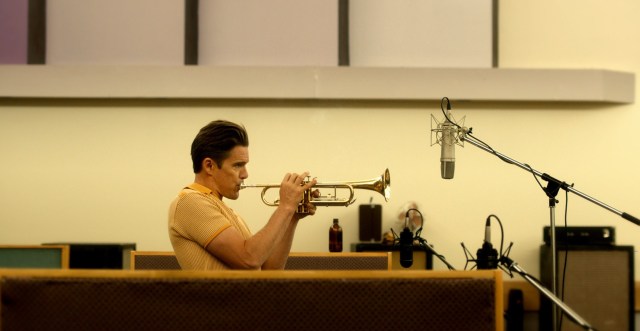
The film takes place in the midst of Miles Davies’ five-year retirement while also telling the story of his relationship with Frances Taylor, who is in equal parts his muse and wife. The film is impressionistic in its storytelling moving from flashback to present day in a dreamlike manner. For example, in one scene Miles is watching Frances dance, and she is about to fall over and then suddenly the scene cuts the Rolling Stone writer Dave Braden (Ewan McGregor) tripping in a stairway while giving chase to Davies in the present.

One can liken the film’s style to a Jazz piece with impressionism representing the inherent improvisation quality of the musical genre. However, the technique occasionally becomes clumsy as the past and present become muddled in what they are trying to convey. For example, in the third act, we witness Davies’ apparent paranoia that Frances is with another man which is contrasted with him attempting to get back his music tape in the present. As the moments continue, they do not feel seamless or aligned in what they are showcasing, which makes the editing feel incoherent.

However, Cheadle’s subtly is to be applauded. He does construct great moments that are visually indicative of a character or idea. The best example of this is in the aftermath of a violent fight between Miles and Frances. Davies gives Frances an expensive necklace and soon after he gently wraps his arms around her neck. The shot lingers for a good ten seconds, and it strongly illustrates Miles’ controlling nature. He consistently perceives his wife as an instrument which he can easily play, which this moment cleverly conveys in an engaging manner.

Cheadle plays the titular Miles like a hissing cobra that is on the verge of attacking. His words crackle with contempt and a lack of patience, which speak to five years in semi-retirement. However, this prevailing attitude is contrasted with moments of heartfelt emotion which are shown in the smaller moments. One such scene is when Miles is in the elevator of Capital Records. He takes off his glasses and starts looking at the wall which has some of the best-selling album covers of the record label.

In this scene, Cheadle conveys a deep-rooted sadness and a great sense of quiet contemplation of his legacy, which is expressed in his eyes. Additionally, the contrast between Davies in the past and the present is fascinating. In the flashback sequences, the shots of Davies are painterly in composition and innocent in the mood. In some of these scenes, Cheadle brings an indelible charm and infectious energy that is on full display in the moments when he is creating music with his band. It is a brave, bold and ambitious performance, which along with the style of the film tremendously make you feel the power of Miles Davies’ music.

Posted in Uncategorized | Leave a comment

Review: The Jungle Book (2016)

maxresdefault

Quite simply, I was captivated by Disney’s live action interpretation of The Jungle Book. In a year where films such as The Hateful Eight and 2001: A Space Odyssey have renewed my faith in the longevity of the cinematic medium, Jungle Book has fundamentally cemented my view that contemporary cinema can still excite and makes us wonder.

The film is an outstanding example of computer generated imagery being employed effectively. Part of this comes from the effects being used to create an environment that we are familiar with in nature, which is the jungle. However, like James Cameron’s Avatar, the magic of the effects manifests itself in the small little details. The one scene that is indicative of this is when Mowgli (Neel Sethi) meets Kaa (Scarlet Johanson)

Firstly, the build-up to the meeting is illustrated through a change in the colour scheme, which begins with idyllic and radiant uses of yellow and green. These then turn into harsh and desaturated uses of brown, black and green. Secondly, there are many lingering moments where the camera is focused on the ground that shows many of the previously victims of Kaa, which creates a great sense of dread and tension. Finally, there are a measured number of shots that represent the sheer size and majesty of Kaa, which is seen from Mowgli’s point of view as his eyes dart around his bleak surroundings. These moments also shows us another fascinating facet of the jungle, which is the main attraction of this live-action version of Rudyard Kipling’s much-beloved story.

Through his film-making, director Jon Favreau brings the titular jungle to vivid and enchanting life. Whether it is the kinetic and sweeping opening sequence that showcases Mowgli keeping up with his wolf pack via tree swooping. Or the stop motion sequence that depicts the changing seasons of the jungle in a strikingly painterly series of shots. Favreau’s conception of the Jungle stimulates the imagination as much as Cameron’s Pandora.

However, there is more to the picture then its effects and visual look. The film has a compelling primary theme that differentiates itself from the 1967 animated feature. The film is an exploration of man’s ingenuity. On the one hand, it can engender destruction, which is shown in the fear of fire that the animals in the picture dub as “Red Flower.” On the other hand, man’s ingenuity is illustrated as a beneficial thing which is shown in Mowgli’s acts through the course of the film. At first, the animals view the man cub’s inventiveness as mere tricks which fundamentally makes him an outcast.

However, this view is changed at the end of the film when the animals realise that Mowgli’s inventiveness is intrinsically good for their community. He uses self-built tools to free a baby elephant from a pit and devises a way for Baloo (Bill Murray) to have a constant supply of honey for his hibernation.

The theme has particular resonance in the final confrontation between Mowgli and Shere Khan, who is voiced with superb eloquence and savagery by Idris Elba. The man cub comes back to face the fearsome tiger with a burning branch. While running back to his home, Mowgli accidently causes half of the forest to burn. Khan uses this as a crutch to persuade the animals of man’s true nature.

The brave man cub decides to throw this piece of fire in a nearby lake and decides instead to face the tiger with his ingenuity. Crucially, this moment has the two conceptions of man’s ingenuity in conflict with one another and quite assuredly, Mowgli decides to use his wits as opposed to a destructive weapon to defeat Shere Khan.

In the original there was a fatalistically resigned fate for Mowgli, which was that eventually he would embrace his humanity and leave the jungle. Whereas in this live action version, Mowgli’s humanity and ingenuity proves that he can live in harmony with nature and the jungle that he calls home.

Posted in Uncategorized | Leave a comment

Concise Review: What We Do in the Shadows (2014)

what-we-do-in-the-shadows1

What We Do in the Shadows confidently and firmly drives a stake into the heart of cultural affinity for vampires. Through its candid documentary style, Shadows remarkably makes the life of the creature of the night look banal, mundane and pathetic. Primarily, this is illustrated in the inherent domesticity of the immortal beings, which effectively juxtaposes with the visual showcasing of the vampires’ former lives.

Each of the characters are explorations of longstanding vampire archetypes. Vladislav (Jemaine Clement) is a clear homage to Vlad the Impaler, who is said to have been a significant influence on Bram Stocker when he conceived of Dracula. Deacon (Jonathan Brugh) feels like a channelling of Colin Farrel’s overtly macho Jerry in the Fright Night remake that came out in 2011.

Quite clearly, Petyr (Ben Fransham) is a visual homage to the cinema’s first conception of the vampire which is Max Schreck’s immortal performance in F. W. Murnau’s Nosferatu. And the overly cautious head of the household, Viago (Taika Waititi) is the closest in embodying the romantic spirit of vampires, which is showcased in a subplot where he discusses his long lost love.

At the same time, the film also showcases the fundamental melancholic edge that comes with being an eternal being with a sub-plot where a human becomes a vampire. Crucially, the film addresses this existential angst without ever feeling the need to compromise its comedy, which is the picture’s primary strength. It essentially lovingly mocks these supernatural creatures that have fascinated audiences since the dawn of cinema.

Posted in Uncategorized | Leave a comment

Review: War of the Worlds (2005)

wotwdefense__span

There is something distinctively vintage about Stephen Spielberg’s loose adaptation of HG Welles’ famous science fiction novel, War of the Worlds. One of the ways that this is the case is that Spielberg creates a visual look that has a remarkable resemblance to a black and white film. At times, one is convinced that they being transported back to the 1950s.

The desaturated and murky grey look complements some of the film’s dramatic moments. One of the scenes where the visual scheme casts the most substantial impression is when Ray Ferrier (Tom Cruise) comes back into his house after witnessing the destruction that a Martian tripod has left in its wake. Ferrier looks utterly bewildered and shocked that he cannot talk for a few minutes when his children ask him what’s wrong nor shake off the white dust that he has all over his face and jacket.

This seemingly quiet and still moment is missing some Bernard Hermann inspired music which would punctuate the moment of Ferrier reflecting on the grisly acts he has witnessed and the implications that they have on the survival of his family. However, as the scene stands it feels like it has the weight of the latter scenes in Don Siegel’s Invasion of the Body Snatchers.

Spielberg also continues his showcasing of a bleaker outlook on humanity which started with AI: Artificial Intelligence and continued with the compelling and masterfully crafted Minority Report. In this picture, Spielberg illustrates that while humanity is the master of a domain that it has thrived in for centuries, our survival instinct has made us monstrous. The clearest example of this idea being articulated comes in a scene in the middle of the film. Ferrier and his children are driving slowly through a swarm of people, and some of the people take it upon themselves to attempt to take the car through violent means away from Ferrier.

The idea is also strongly expressed when Ferrier and his daughter, Rachel (Dakota Fanning) are taken in by Harlan Ogilvy. (Tim Robbins) Ogilvy is a paranoid person who is determined to attack the aliens back even if it means endangering the people around him. Robbins plays Ogilvy with a great sense of harsh logic and heartbreaking fragility.

Nevertheless, Spielberg’s central illustration of humanity is at it’s most potent when he employs his usual point of view shots from the children’s perspective. In the case of this picture, there are many haunting perspective shots from Ferrier’s daughter, Rachel.

The most striking of which is when she is witnessing an active streaming river. The music and shot composition suggest that the moment is a calm and magical interlude from the destruction that we have seen. However, this momentary thought is shattered when she starts seeing a large assortment of dead bodies pass her by in the flowing river. In this one scene, Spielberg strongly illustrates that in the battle for our evolutionary dominance, our fundamental quality of innocence that comes in the form of our offspring is lost and in some sense our humanity is too.

Posted in Uncategorized | Leave a comment

Review: Batman V Superman- Dawn of Justice (2016)

12747723_178099502569945_1572198020_n

In the midst of the colossal central fight between DC Comics’ foremost superheroes, a thought emerged. Despite, the superficial thrills of the battle that involves some of the best effects and action that Hollywood could afford, the fight was intrinsically personal and thematically potent. The Man of Steel was reluctantly fighting the Dark Knight in order to save his Mother. Whereas, Batman’s (Ben Affleck) reasoning for opposing the Kryptonian being was because of a fundamental belief that Superman (Henry Cavill) represents an incredibly real threat to humanity after he witnesses the destruction the super powered being is capable of in a harrowing and effective opening scene.

Bruce Wayne’s overriding viewpoint is punctuated by a scene in which he looks upon the graves of his parents and briefly describes his family’s history to Alfred. (Jeremy Irons) He pointedly expresses that his ancestors were hunters who did benevolent deeds. If Batman V Superman: Dawn of Justice is about anything then it is about the weight of ancestral and parental expectation that shapes and drives the moral compulsions of our titular characters.

Towards the end of that battle, Batman mocks the Man of Tomorrow by saying “I bet your parents taught you that you mean something, that you are here for a reason.” The Dark Knight’s pointed insult is at the Kent’s upbringing of Clark Kent and by extension his impetus for doing good. Soon after, Batman states to Superman what his parents taught him which was that if do you do not understand the world, then you have to force it too, which crucially speak to his determinism and resolve to eliminate the Man of Steel. As the hardened and older Bruce Wayne/Batman, Ben Affleck stands out. He brings a deep seeded weariness and cynicism as well as an overt and fascinating vulnerability that manifests itself in the final act when he is fighting with God like beings.

The most surprising performance of the picture comes from Jesse Eisenberg as Lex Luthor. He plays the character as though he has too many thoughts circulating in his head and he wants to articulate them all at once. This aspect of the performance may appear too quirky for its own good. However, it truly masks a fundamentally fragile and terrifying malice. Both of these facets of Luthor’s character are illustrated in the scene where he threatens Superman.

In this scene, it is strongly suggested that Luthor’s hatred of the Man of Steel comes from the fact that a God type person was not there to save him from his father’s constant abuse while he was growing up. Eisenberg’s drops the previously portrayed frantic awkwardness and is instead so clear and cutting in his words to Superman. The scene is emblematic of an another theme that is explored through the course of the film, which is whether or not Superman’s actions are truly helping humanity or threatening it. For every life, he saves, another one is tragically cut short. It is a paradoxical notion that the picture bravely acknowledges in its examination of DC Comics’s greatest superheroes.

Despite these commendable themes and performances, the inherent problem with Batman V Superman is that it represents Zack Synder’s least visually interesting film to date. While there are a few scenes that are cinematically compelling such as a one-take action sequence where Synder masterfully employs the grandeur of the IMAX format. There are hardly sequences in this picture that are cinematically exciting. Man of Steel impressed with its sheer contrast between the HR Giger inspired visual scheme of Krypton and the natural radiant and authentic visual look of the Kansas sequences.

Moreover, none of the film’s various dream sequences compare with the apocalyptic dream sequence in Watchmen, which was visually stunning with its dark brown and orange colour scheme. It is a scene that directly addresses the external threat of the story. It also powerfully spoken to the fear of one of the characters in the film. It is a shame that nowhere in its 133 minutes running time that Batman V Superman: Dawn of Justice does not have a potent cinematic moment quite like that.


Posted in Uncategorized | Leave a comment

Concise Review: Sin City- A Dame to Kill For (2014)

Hc3zkCb

Sin City: A Dame to Kill For is a lesser effort compared with its predecessor. Unfortunately, this is partly due to the astounding visual look of the original picture feeling rather cartoony and less impactful. Moreover, the violence in A Dame to Kill For seems excessive and uninteresting whereas in Sin City it was artful and gut-wrenching. Additionally, despite the addition of new material by the comics original scribe, Frank Miller, most of the storylines are not that interesting and are fundamentally one-note in their overarching focus, which is of the corrupt Senator Roark.

However, the film is somewhat redeemed by its performances, particularly by Eva Green and Josh Brolin, who are the main players in the title story. Green is a tantalising portrait of a steely and despicable femme fatale. On the other hand, Brolin is excellent as a broken and hard-edged man, who is fundamentally afraid of embracing his monstrous nature. Finally, the first narrative thread which is entitled, The Long Bad Night is commendable because of its initial light touch with its noir conventions, which then takes a nasty and ultimately tragic turn that best explores the character of Senator Roark and Basin City.

Posted in Uncategorized | Leave a comment

Concise Review: Sicario (2015)

thumbnail_3503

Sicario is a haunting crime thriller that illustrates and explores the morally grey tactics that are employed when facing the Mexican drug cartel. The film considers that each side uses harrowing tactics. In the penultimate scene, Fausto Alarcon (Julio Cedillo) asks Alejandro Gillick, who is played with fierce intensity by Benicio Del Toro, “Who do you think we learnt it from.” Gillick’s involvement in the war on drugs resulted in him losing his wife and daughter in harrowing incidents. Moreover, through his character we see that the American side has resorted to ruthless personal sentiment and illegal tactics to combat the war on drugs.

The violence in Sicario is excellent because of its matter of fact manner and the psychological effect it has on its characters. The most evocative example is in the previously mentioned scene with Gillick and Alarcon. Without remorse and with terrifying precision Gillick shoots Alarcon’s wife and children. He then proceeds to ask Alarcon to finish his meal. We then see a fleeting shot of Alarcon’s dead family and then cut to his facial expressions, which are stunned, utterly fearful but have a contrary sense of quiet defiance. The violence in the scene feels real, raw and gut-wrenching to witness.

Finally, the film has a strong central performance from Emily Blunt. A lot of the shots in the picture are of the lingering expressions of Blunt’s character, Kate Macer. In these quiet moments, Blunt’s portrays an acute sense of deep seeded thinking and doubt, which strongly emphasises the film’s moral murkiness.

Posted in Uncategorized | Leave a comment

Review: Hail Caesar (2016)

56b3e7e3adebb.image

Hail Caesar opens with a narrator (Micheal Gambon) who dramatically sets the scene for the story of Eddie Mannix, (Josh Brolin) who is a problem solver for the studio Capitol Pictures during the era of 1950s Hollywood. At first, the moment feels jarring however it is a crucial scene that illustrates the brilliance of Hail Caesar. The film is a delightful celebration of a lost era of moviemaking. At the same time, it also works as a lampooning of the tail end of the studio system.

The former is showcased in lavish sequences from the pictures that are made by Capitol Pictures. One particular standout set piece depicts an ambitiously spectacular aquatic performance which has actress DeeAnna Moran (Scarlett Johanson) front and centre. Moran’s entrance plays like something out of a James Bond opening credits sequence. It is artful and purposeful in articulating the central theme of the film.

Hail Caesar is concerned with making us believe in extraordinary things through the power of the cinema. In one way this applies to the title film which is about a Roman centurion who comes to believe in the power of Jesus Christ. At the same time, it also refers to the previously stated scene with DeeAnna Moran. The performance makes us believe that the actress is a portrait of captivating innocence, which is an image that is instantly shattered when she begins talking with Eddie Mannix about her problems.

In the scenes with Mannix, she is a shrew, irresponsible and the complete anthesis of her perceived starlet image through the course of that marine performance. In an amusing sub-plot, Mannix tries to cover up the actress’ surprise pregnancy by getting her to adopt her future child.

The film takes on a strange new life when ordinary moments outside of the pictures at Capitol Pictures feel like idealised movie moments that make the audience believe in wondrous things. For example, there is a single scene where Hobie Doyle, who is played with touching sincerity, by Alden Ehrenreich starts doing tricks with a rope while waiting for his date.

On its own the moment is absurd. However, it truly evokes the primary theme in a compelling manner. Joel and Ethan Cohen reinforce idealisation of the movies into moments that are meant to feel mundane and unnecessary. It’s as though the audience always want to believe that Hobie Doyle has that same persona of a naive, innocent cowboy who can impress with his charm and tricks.

At the same time, the film mocks the studio system in one of its central plot points. One of Capitol Pictures’ main players who is the leading star of the title film gets kidnapped by an organisation called The Future. They are a communist congregation who believe in the equal rights of writers in the filmmaking process. The scenes between the various people in the assembly and Baird Whitlock (George Clooney) are some of the funniest scenes in the picture.

This is because of the counter-intuitive nature of the scenes. Instead of being a horrible and terrifying set of people, the Future are portrayed as reasonable, amusing and learned as they debate the implications of their kidnapping to Whitlock. Additionally, they express the excessiveness, egotism and sheer lack of artistic merit of the studio, which contrasts well with the visual showcasing of the pictures made at Capitol Pictures.

Clooney plays Whitlock like someone who constantly needs a script to keep going otherwise he loses all semblance of thought and speech, which culminates in the funniest scene in the picture. Whitlock returns to the studio and explains in great detail to Mannix about the Future’s communist belief system which includes pointing out the inherent greed of the studio.

Clooney’s matter of fact wonderment contrasts very well with Brolin’s pent up rage, which results in a sequence that epitomises the importance of movie stars. Finally, the scene embodies the primary thematic fixation about belief in the power of the movies as Mannix slaps around Whitlock and reminds him that he is an actor that has to make people believe in the power of faith in his dramatic final scene in Hail Caesar.

Posted in Uncategorized | Leave a comment