
Preamble
It’s an absolute testament to the writing process that despite a late screening and barely any shut-eye, the blank page will always be filled. But enough about my Friday nights. Have you had a chance to see Christopher Nolan’s adaptation of The Odyssey? Let me know in the comments below.
Review

From Inception to Oppenheimer, it’s almost become a recurring joke to say film x is the culmination of Christopher Nolan’s career. However, a good case can be made for The Odyssey, which to date is easily the director’s most powerful and subtextually engaging effort.
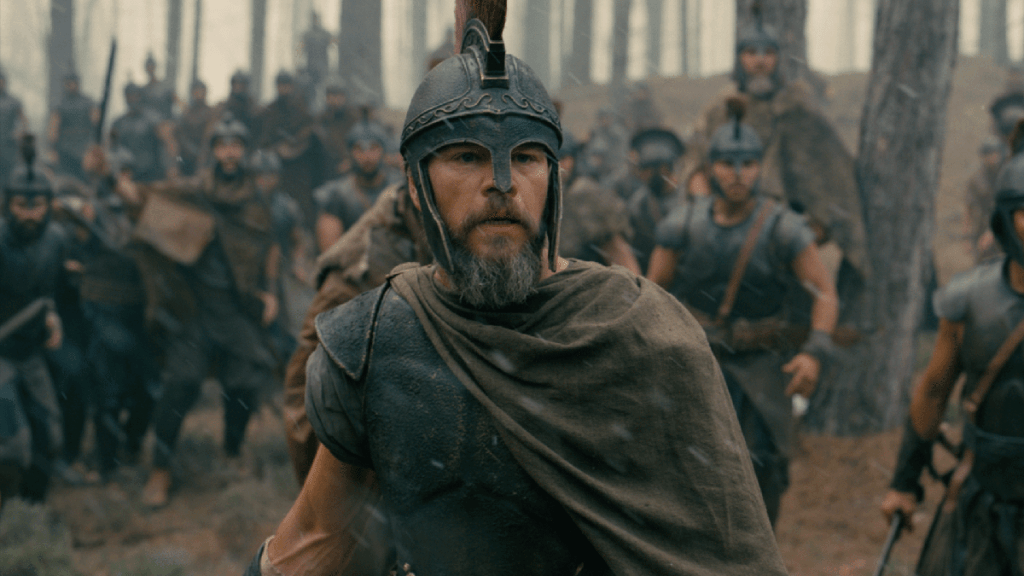
Based on Homer’s poem of the same name, The Odyssey tells the story of a Greek king called Odysseus (Matt Damon) and his long journey home from the Trojan War. Meanwhile, his son, Telemachus (Tom Holland) and wife, Penelope (Anne Hathaway), preside over a kingdom (Ithaca) that is slowly falling to ruin, due to several suitors, who have outstayed their welcome by sucking dry their food, wealth and hospitality.
A large part of the potency of Nolan’s adaptation of The Odyssey lies in how war serves as the canvas for the human condition, namely the atrocities committed during it. Do they lie at the feet of the generals who command it? Or are they enacted by soldiers whose penchant for violence, control and desperation can be like an unquenchable fire.
Framed through this lens, Odysseus’ various mythological adventures become mediations on this quandary. The Cyclops sequence is an example of how a general’s cruelty is all- consuming when life has been taken and survival is in the balance. By the same token, the Circe (Samantha Morton) scenes presuppose that soldiers’ relish for violence and conquest is a natural human appetite that must be confronted.
Nolan’s ethos and conclusion in this debate are a demythologising of the Trojan Horse. Rather than a sly trick that’s often told in songs and legends (including an opening ballad by a bard- played by Travis Scott), it’s a Pandora’s Box that unleashed unspeakable cruelty that violated the natural law of the day (namely Zeus’ Law).
Not only does this have thematic ties to Oppenheimer, which equally depicted a man’s struggle with a creation that violated natural preconceptions of the world, but it also has ties to Dunkirk in two ways. The first is war from the general’s perspective, insofar as what desperation makes them do. The second is how the film handles Winston Churchill’s famous “Fight them on the beaches” speech. Rather than being a positive affirmation of strength, it brings no relief to one of the soldiers who returned (as illustrated by the film’s haunting final shot).
This continues Nolan’s preoccupation with how history is defined by the collective rather than the individual. In The Odyssey, there’s a seesaw between how the collective lionises Odysseus and how the man himself abhors what he’s done in the name of war. This gives rise to the character possibly being an unreliable narrator, with the mythological elements as a form of PTSD, grappling with a decade-long war that pushed him and his men to the moral limit.
Matt Damon is a formidable screen presence as the titular character. However, his best moments come at the tail end, when he’s an almost ghostly presence, confessing to the ills of his character and deeds. Equally as striking is Samantha Morton as Circe, whose quiet intensity hints at surprising vulnerability and darkly comic spirit.
Nolan’s direction proves to be a double-edged sword. On the one hand, the most outstanding parts prove to be the Troy aspects, whether it’s a long shot of Agamemnon (Bennie Safdie) being framed like a mythic Greek version of Terminator or the tight close-ups within the Trojan horse that recall the breathless tension of certain sequences from Dunkirk.
And in his best directed moment, Nolan uses a medium shot to vividly illustrate a point of subtext. The scene has Menelaus (Jon Bernthal) grab his wife, Helen (Lupita Nyong’o), by the face. He shows one side that reveals her beauty, whilst saying, “The face that launched a thousand ships.” The character then reveals the other side of his wife’s face, which has scarring from the abuse she’s no doubt been put through. She says in response that the Trojan War was started by Agamemnon’s ambition. The moment is a beautiful distillation of the myth and reality of war that clash with one another, its romantic aspirations and its hard, bearing reality. It’s as close as Nolan has gotten to Ingmar Bergman in showing the power of the human face and all of its complexities.
On the other hand, I found Nolan’s direction of the mythic set pieces to be lacking. In certain regards, they start off well, such as the lighting and imposing use of low-angle shots in the Cyclops sequence. But the longer they go on, the more the initial momentum is sharply dissipated like a needle to a balloon. The aforementioned Cyclops scene is framed like a heist scene whereby the characters are shown to carry out a course of action before it’s revealed that it’s not real. This happens a few times and robs the scene of its tension as you’re not sure if what you’re seeing is real. Even the commendable Circe scene (in which Circe slowly transforms Odysseus’ men into pigs) is intercut with Odysseus hunting a deer. It never lets the audience stay with the horror; instead, it distracts from it in a way that feels quite jarring.
In the past, Nolan and his editors have been able to intercut quite elegantly (such as a scene in The Dark Knight where Commissioner Loeb is killed by poison whilst a judge is blown up in a car). However, in The Odyssey, these instances either take away from a central sequence or, in the case of the final confrontation, prove to be overwrought.
Finally, Ludwig Göransson’s score proves to be an absolutely beautiful soundscape of electronic music, gongs and traditional Greek instruments. These are all articulated in the pulse-pounding track ‘Troy’ that plays like the central character’s frantic desire to win the Trojan War.


