
Preamble
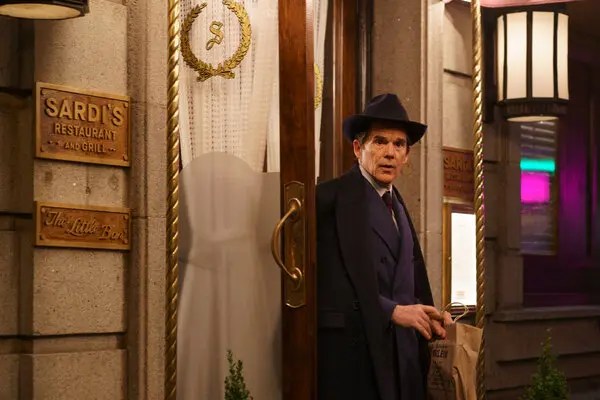
If there’s one virtue of the Oscars, then it’s the spotlight on certain films. Blue Moon has been on my radar since its limited UK release in November, but it finally got my attention with its two nominations (Best Original Screenplay and Best Actor for Ethan Hawke). And I would be remiss if I did not mention the recent passing of Catherine O’Hara. Although I haven’t seen the entirety of Home Alone, her work in the Beetlejuice movies has been very formative for me. And she will be missed in the upcoming season of The Studio. In the first season, she proved what an indelible comic spirit she had, and I will miss her dearly. With that said, what’s your favourite Catherine O’Hara performance? Let me know in the comments below.
Review
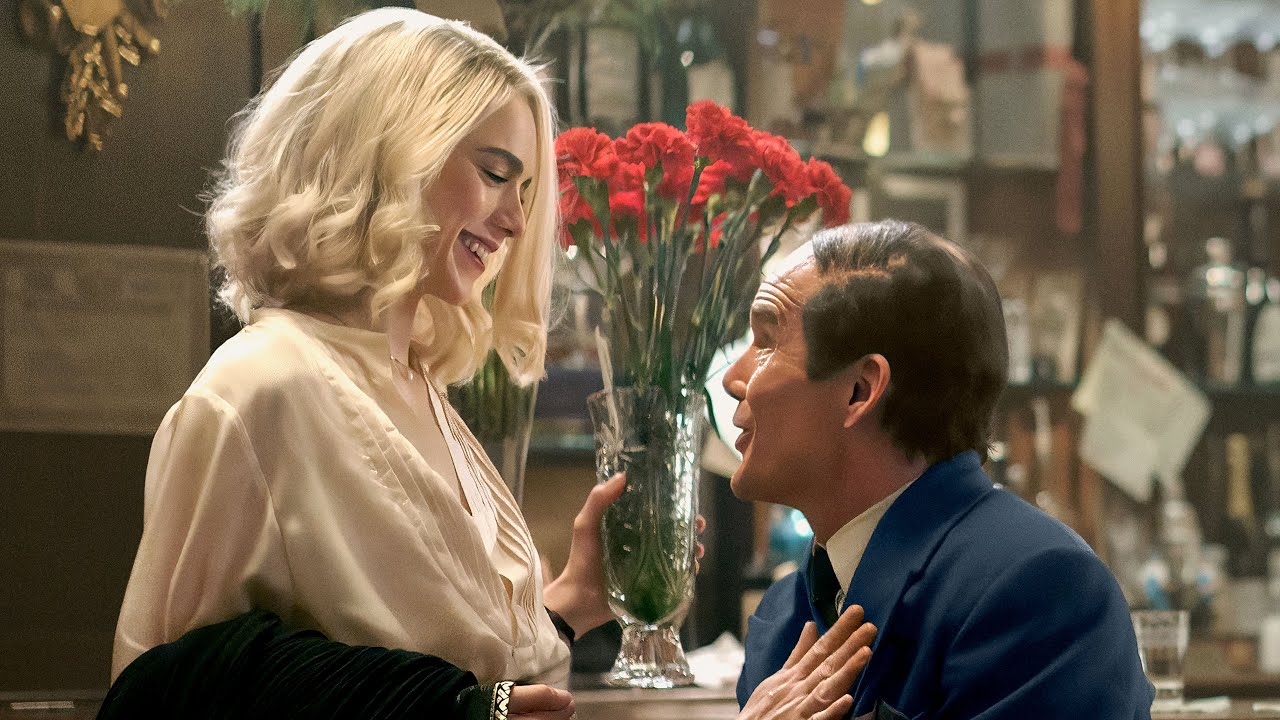
Early into Blue Moon, a smug bartender, Eddie (Bobby Cannavale), says to celebrated lyricist, Lorenz Hart (Ethan Hawke), “Do you ever think your entire life is a play and that, you know, 99% of the people in it, they got no lines, you know? They’re just like extras.” Such is the nature of Blue Moon, a casual slice-of-life picture in which its central character slowly discovers his growing irrelevance. Primarily set at Sardi’s bar, the film depicts Hartz confronting the fallout from his former partner’s first hit, “Oklahoma!”
Whilst Richard Linklater did not write the movie, the script (courtesy of Robert Kaplow) does include elements of Linklater’s real-time style. This takes the form of a structure in which Hart interacts with the players at the bar and around the restaurant. As such, it’s akin to a Before movie in slow motion, where the focus is not on how the characters interact with the environment but on the people around them. At the same time, the Oscar-nominated screenplay has the biting dissection that graced early Kevin Smith and Quentin Tarantino movies, particularly in an early scene where Hart and Eddie discuss the ultimate meaning of Casablanca.
Ethan Hawke is captivating in a central performance that feels suitably showy for its nomination. However, within that largeness where Hawke commands the room, there’s a subtle sense of performance. Hart modulates himself according to the company he’s in, and Hawke portrays these shifting states with an ease that feels authentic and moving. But it’s in isolation that the actor shines, particularly in the closing scenes, when he realises he’s become the embodiment of the song ‘Blue Moon’.
Equally as striking is Margaret Qualley as Elizabeth, who represents Hart’s muse and love interest. In what could have been a throwaway part, Qualley brings a sense of groundedness and self-respect that goes a long way toward making us see beyond Hart’s rosy picture of her. And Andrew Scott impresses in a supporting role as Hart’s former colleague, Richard Rogers, whose facial expressions and gestures offer the audience the most nuanced portrait of the celebrated writer.
In terms of filmmaking, I really appreciate that Linklater avoids making the entire enterprise feel inherently stagey. He does this by being intimate with the camera, with close-ups being a fixture that show Hart in his element. These are contrasted with quite detailed medium shots in which he blurs the background of passers-by. This conveys the quality of Sardi as a living, breathing place, while also giving the audience a tantalising glimpse of what lies beyond the frame.
The filmmaking choice also reinforces the push and pull of whether the people Hart surrounds himself with are extras or if he’s slowly becoming an extra in the lives of people who were important to him. It’s a testament to Blue Moon that, in that quandary, it feels light and charming enough that the answer is a slow, dawning realisation for audiences, much like it is for Hart himself.

 SGS On Film