
Preamble
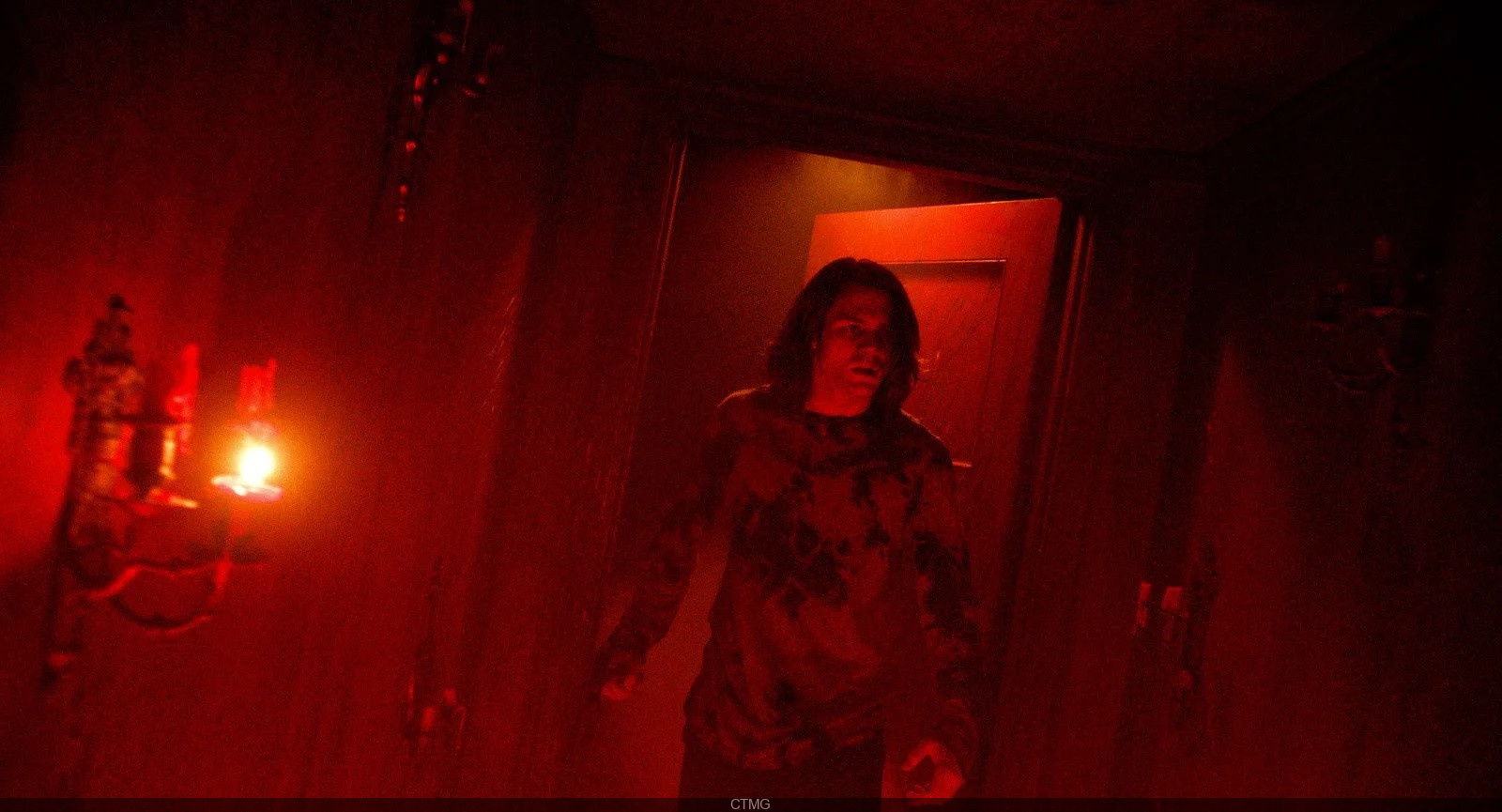
There’s nothing quite like a wave of summer weather juxtaposed with the cool air con being blasted in a cinema screen to put a spring in one’s step. You add a horror movie to that equation, and life is just bliss. Before I go on and turn this into an eye rolling exercise into sentimental weather reporting, let’s get to the main feature. Not much to say here folks, except this will mark my first time writing about the Insidious movies. And let’s just say this fifth film in the series is an interesting way to enter the ground floor of the entire franchise.
So, with that said, have you seen Insidious: The Red Door? Are you planning to see it this weekend? Let me know in the comments below. And if you like my ramblings on horror, then you can find more at my second home, Horror Obsessive. My recent post is part of the site’s Slasher Saturdays series and is a review of the 1986 movie- Slaughter High.
Review

In contrast to its more venerated horror cousin, The Conjuring, the Insidious films have by and large worked for me a lot more. This is mostly due to them never feeling as though they were playing dress up with their horror inspirations. Instead, they take the spine of them (mostly in the form of Poltergeist) and use them as a jumping off point for effective and intimate bump in the night affairs that ooze cinematic style. This came down to director James Wan (co-creator of the Saw franchise), who effortlessly bridged the gap between the torture porn he helped form, and the Oren Peli inspired found footage fare (courtesy of Paranormal Activity).
Even in the flawed Back to the Future Part 2 inspired sequel, I at least admired Wan and co-screenwriter Leigh Whannel’s attempt to tackle horrific subject matters such as childhood abuse (despite exposing the central problem with the series, which is overcomplicated lore dumping). For better or worse, The Red Door inherits the sins of its franchise forebears but tackles its more difficult themes with far more empathy and tact.
The latest Insidious picks up ten years after the events of Insidious: Chapter 2. The central couple, Josh Lambert (Patrick Wilson) and Renai Lambert (Rose Byrne) are now divorced, and their kids, Dalton (Ty Simpkins), Foster (Andrew Astor) and Kali (Juliana Davies), primarily live with their Mum. After taking a series of art classes, Dalton and Josh, start to experience strange happenings as their past with the supernatural starts to catch up with them.
For a lot of its running time, The Red Door plays like an inverse of the first Insidious picture, whereby the characters slowly realize their gifts and connection to the supernatural. On the surface, this would sound like a chore (given that the audience is a step ahead of the characters). However, the choice sows the seeds for some fascinating themes.
The Red Door is about many things. But one of the things it advocates is that repression is inherently a bad thing when attempting to deal with trauma. Instead, it advocates how art (quite literally in the form of Dalton’s artwork) can be helpful in bringing light to starker elements of the past. By the same token, it’s empathic to the child’s perspective when reflecting on Chapter 2. Most of the audience are aware of the plot machinations of the second film, where Josh is possessed by the infamous “Bride in Black.” However, The Red Door takes the view that because the attacker still retained the face of their father, the Lambert kids are traumatized by Josh attacking them and their mother.
This is a far cry from the more clumsy attempt at tough subject matter in Chapter 2, whereby child abuse led to the Bride in Black’s persona as a serial killer. However, The Red Door is still not entirely immune to this problem that plagued the first sequel. There’s a sub-plot involving Josh coming to terms and realizing his father is attempting to make contact with him from beyond the grave. It plays as oddly as it sounds and feels like an awkward attempt to harmonize with plot a’s theme of generational trauma brought about by the paternal figure.
There’s a plot point in the movie’s third act that attempts to deal with this aspect insofar as the supernatural started and died with the father figure. However, the movie decides to go for a softer and more sentimental ending.
What’s ironic is that Josh’s sections contain The Red Door’s most excellent instances of filmmaking. In his first directorial effort, Patrick Wilson trades in the slightly showy (in a good way) direction of James Wan for something more subdued and subtle. The standout scene is when Josh is playing a memory game involving photos of his kids that cover up some sections of a large glass window. Through the use of long shots and subtle playing with the foreground of what the audience sees in the window (after Josh lifts each photo flap), Wilson creates a suitably creepy scene that plays on the audience’s imagination.


