
Preamble
I’m coming to this preamble at the 11th hour insofar as editing before going to see a movie shortly. Despite being stuck after writing the first paragraph for this review (for a good long while), it’s amusing how that’s now become the case for this little intro. But anyways, have you seen Episode 6 of the Last of Us’s second season. Let me know in the comments below.
Review

So far, the second season of The Last of Us has not been afraid to wrestle with its source material insofar as adhering to its unique structure whilst adding to its themes. The season’s penultimate episode, The Price, is perhaps the boldest episode to grace the series and its preoccupation with parental love. Taking place over several years, the sixth episode depicts the ever-increasing souring of Joel and Ellie’s relationship as the young woman tries to navigate the complications that arise from being a teenager in a post-apocalyptic world.
Rather than doll out each Joel flashback in a piece-meal fashion, The Price uses them to weave a narrative about Joel and Ellie’s surrogate father/daughter dynamic. The result is something that feels thematically strong in getting to the heart of what the video game and show is about, namely the lengths we go to protect the ones we love. At the same time, the episode illustrates the hope that all parents have, which is articulated in an early scene involving a young Joel and his police officer father.
It’s the hope that each subsequent generation of male parentage can do better than the last insofar as a cycle of violence is concerned. The added back story suggests a capacity for violence that is at once an act of love as well as a means of discipline. The echoes of Joel’s father’s rationale for violent action are haunting in how they paint the character at his most cruel and merciful.
This comes to the fore in how Joel deals with Eugene insofar as taking him out before he’s a danger to him, Ellie, and the community at large. It speaks to how Joel correlates violence with love and how one cannot exist without the other. It broadens the scope of the cycle of violence exploration in the game by showing it through the character who ignites it in the first place.
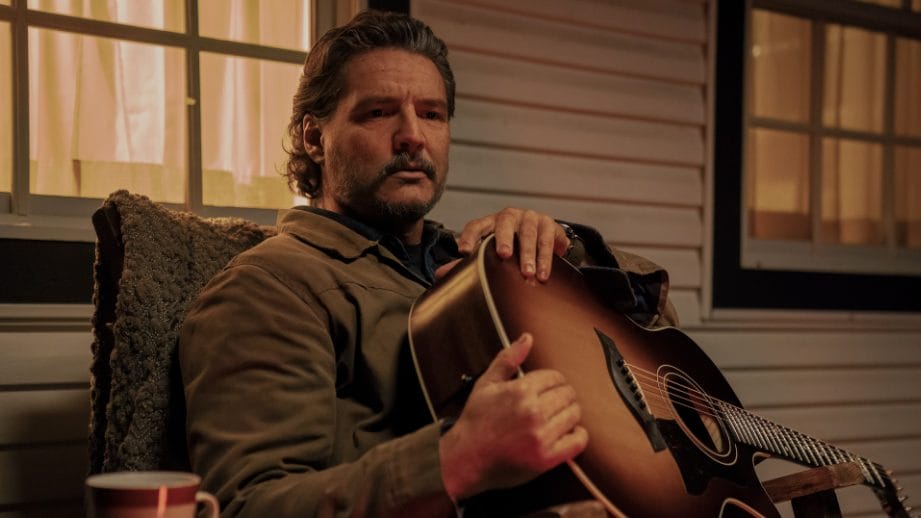
The episode speaks to how much of a boon Pedro Pascal has been for the character of Joel. His best acting moments are the ones where there’s a push and pull between the stated and unstated. This is best shown in the porch scene where the character gives a series of nods to some questions posed by Ellie. It culminates in an outpouring of sentiment from the character that feels heartbreaking and emotional to witness. But it also shows how the shell of the character is fundamentally broken, that he has to resort to quoting his father’s words in what feels like an act of shame and an admission of guilt for his failure as a human being. It’s a very powerful moment, despite clearly underlining and putting the broader subtext of the show in bold.
This quality, along with some of the recreated video game moments not having the same weight does drag down the episode. However, some of the new material does work in illustrating a fascinating what if situation for Joel trying to raise an adolescent (given the age that his daughter Sarah died at).
Filmmaking wise, I liked how low-angle shots were used to depict a sense of awe for when Ellie sees a dinosaur. And the closing moments that have the young woman in a medium shot effortlessly portray to distance that Ellie feels from Joel.

 SGS On Film