
Preamble
Well, this is a little embarrassing. There are times when you can emphatically return and state a reason for a long hiatus. And then there are others when you feel like the equivalent of someone who has just stepped onto stage in the middle of a school play and completely blanks on all your lines. Well, without resorting to cue cards or some hyperventilating stage hand who tries their best to jog your memory via a series of violent gestures, I have no excuse. I could point to work and a lack of motivation. But I just think there are times when you don’t feel like you have much to say. I’ve always prided myself on being someone who only speaks when he has something to say, but it’s felt like since my last writing gig, the ink has truly gone dry.
However, when I finally snapped out of it (for lack of a better phrase), I decided to go against this usual mindset and go seek out something where I would intuitively have little or next to nothing to say (due to no prior knowledge). The trailers for the recently released Hunger Games prequel have really made the premise appealing in a way that none of the mainline entries have. So, with this in mind, I decided to hop on my bike (or really just take a leisurely stroll) to my nearest cinema to let The Ballard of Songbirds and Snakes be my ground floor entry for The Hunger Games. Have you had a chance to see the latest entry? And how would series veterans rank it amongst the Jennifer Lawrence starring quadrilogy. Let me know in the comments below.
Brief Consideration

Part way through The Ballard of Songbirds and Snakes, the head gamemaker of the 10th Hunger Games, Dr Volumnia Gault (Viola Davis), pointedly asks a young Cornelius Snow (Tom Blyth), “What are the Hunger Games for?” As a primer for a prequel that explores Snow’s rise to prominence, it’s a clever metatextual question that underpins an impressively powerful prequel. It’s also an accessible lynch pin that stuck with me throughout my time with the film (given I had not seen any prior instalments of the famed dystopian series).
Songbirds and Snakes is at its best when its in service to this question, whether it’s illustrating the function of the games as commercial opportunism in a way that mirrors reality television shows such as the X Factor and Big Brother. Or better yet, a canvas that shows humanity at its best and worst (via the various actions we see of the combatants). In this way, the film gives the impression of a everything or nothing answer but pulls it back enough to see it via Snow’s relationship with the games and the consequences that stem from his involvement with them.
Snow’s journey is a tragedy whereby he’s ultimately doomed and destined to fall in line with his station in life. Part of this growth is expressed cinematically via director Francis Lawrence’s use of Dutch angles and low angle shots. The typically surreal and imposing camera moves are instead used to illustrate the measure of control that Snow has in any given situation. And this question of control is something the film plays with throughout (not only with Snow’s changing attitude but also those of his class mates). With this in mind, the theme of control makes the movie horrific in its depiction of how much we can lose control when stripped of all our basic rights and are instead forced to survive in a harsh environment.
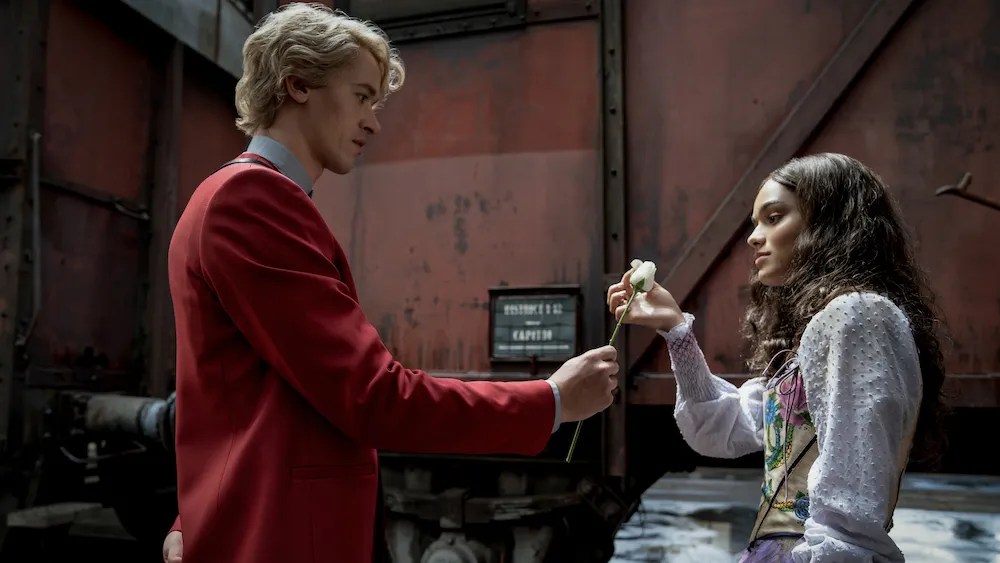
As a young Snow, Tom Blyth is framed as though he’s a young Peter O’Toole with a similar wry charm that comes from small and disarming gestures. Rachel Zegler plays to the crowd in a performance that walks a tightrope between vulnerability and a sly knowingness that comes from her background as a travelling performer. And Viola Davis is a terrifying screen presence as a mentor figure to the young Snow.
Despite being effective in many areas, the film does suffer from its important family details (namely Snow’s parentage and role in the world) being reduced to clunky exposition that’s often tritely dolled out throughout. This problem borne out of an ambitious screenplay does undermine the subtle finessing in Snow’s journey from an ambitious student to an eventual tyrannical figure.

 SGS On Film