
Preamble
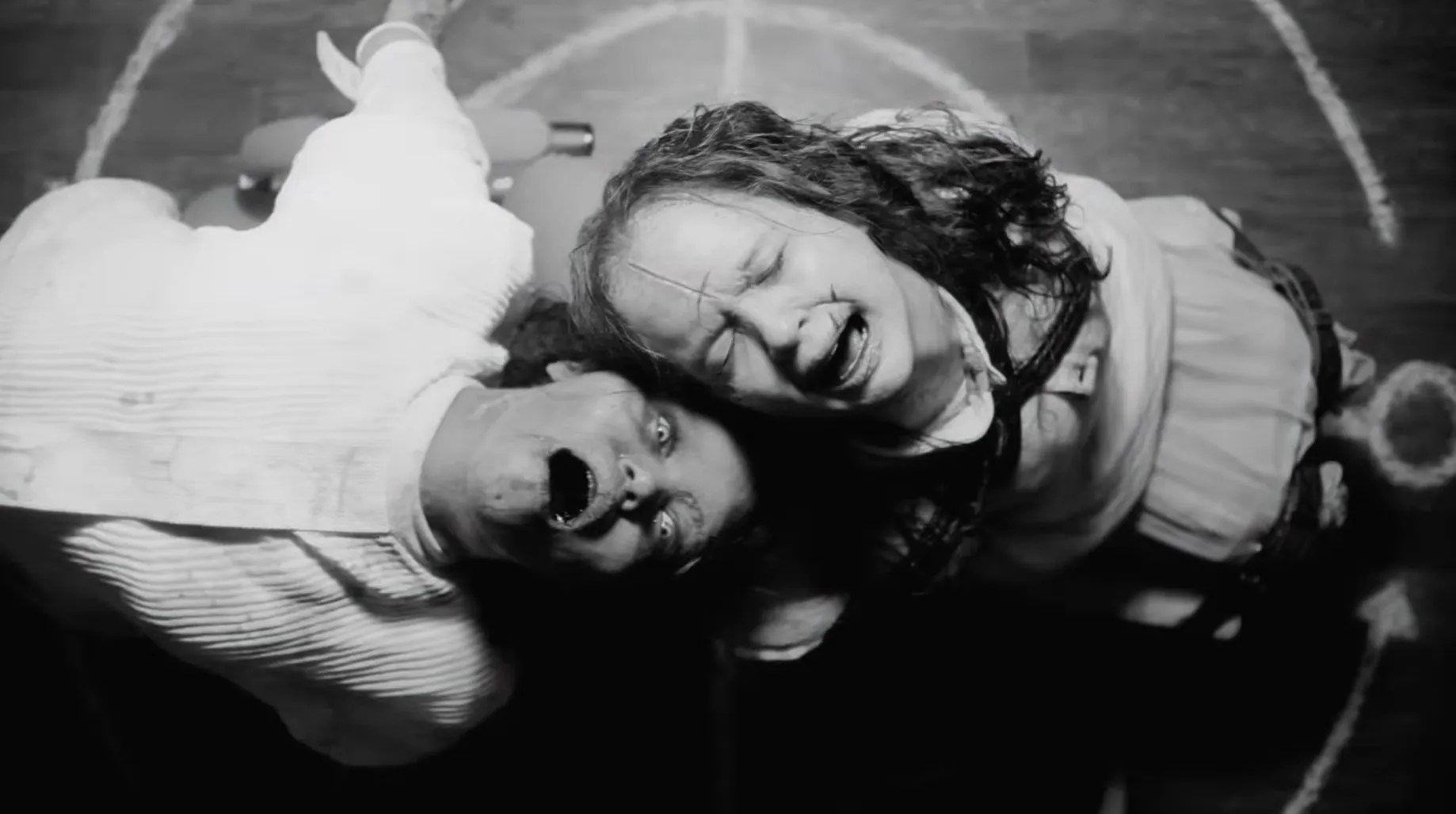
Ever since Halloween Ends last year, I’ve been very curious to see what David Gordon Green does with The Exorcist. In fact, I put the legacy sequel as one of my most anticipated films of the year. Does it live up to the hype? Well you can find out after the jump. Have you seen The Exorcist: Believer? Let me know in the comments below.
And if you like my ramblings on horror, then you can find more at my second home, Horror Obsessive. One of my first posts for the site was a comparison of the two Exorcist prequels.
Review

For a film that’s frequently credited as “The scariest film of all time”, The Exorcist is not a bad choice for the title. Even 50 years on, the 1973 film is richly dramatic and unique in the eeriness it depicts of an omnipresent evil that exists in the most typical of our everyday situations. It’s also an excellent postmodern Bergman film where one of its characters has a crisis of faith that’s renewed in the most horrific way possible. David Gordon Green’s sequel is a fascinatingly flawed effort that made me reconcile the most problematic aspect of the original picture.
After losing his wife during an earthquake in Haiti- widower Victor raises his only daughter, Angela (Lidya Jewett), with the grim spectre of their loss. However, the horror of that experience starts to rear its ugly head when his daughter goes missing with her friend, Katherine (Olivia Marcum). The young girls are found but have no memory of the last 72 hours. They both start to show acute signs of demonic possession, which starts a chain of events that will bring Chris MacNeil (Ellen Burstyn) back into the fold.
Much like his Halloween trilogy, Believer is at once a demythologising of its legacy characters and an illustration of how the weight of events affects an entire community. In the case of the first, MacNeil is seen as a flawed character whose actions have caused her to have a bad relationship with her daughter, Regan (Linda Blair). At the same time, the events of the original film have sparked a desire to educate herself so she can help people who find themselves in a similar situation. The now infamous patriarchy line that’s made most people’s heads turn backwards in anger and derision is as much a frustration at the Church that hired the priests in the first picture as much as a call back to the character protesting in the original.
In this way, David Gordon Green, along with co-screenwriter Peter Sattler have made a film for the post-truth era whereby experts and appeals to authority can no longer be the answer to fighting evil. Instead, the film advocates the importance of community and how the coming together of people from disparate cultures and belief systems is the key to confronting the demonic possession we see unfold. In this way, the Believer subtitle becomes about the faith people have in each other to do what is necessary for the good of community harmony. It’s quite a secular angle to a franchise that’s been wrapped in the blanket of Theism.
Conceptually, I admire these ideas that David Gordon Green is juggling. However, in execution it comes across as hokey and amounts to people standing around in a circle shouting at two girls. Along with some quite spelt out fatalism and moralising in the screenplay, Believer is quite on the nose in its writing. However, the inherent sentimentality of some of these themes made me rethink a problem in the original Exorcist.
In the extended director’s cut of the film, there’s many scenes that either resort to sentimentality or spell out the moral of the film. Most of these changes existed because the novel’s writer and screenwriter, William Peter Blatty, thought they were essential in explaining what the movie was about and did not want to leave the film on a downer. These scenes worked a lot better in the novel and felt quite forced in the documentary realism that permeated the film and William Friedkin’s direction.
In a sense, the sentimentality and hokeyness in Believer made me appreciate that it’s in keeping within the spirit of some of Blatty’s contribution to the original film. It made me look at those choices with much more kindness.
Elsewhere, Green’s direction is solid and quite exacting. The eeriness of the original is captured in quite fixed and patient camera moves. In particular, there’s a recurring visual motif of a long shot of a door throughout. The tension that’s wrung out of these shots is quite effective. This is in addition to some striking imagery. One moment in the tail end of the film paints a character like the elongated alien from Close Encounters of the Third Kind amid a flurry of blue and red police sirens. Moments like this are quite haunting and ethereal.
And in a sub-genre filled to the brim with over the top demonic performances, I appreciated Lidya Jewett’s performance as someone who is forthright in the attitude to the evil presences she has had a part in awakening.
The Exorcist: Believer is an outlier for sure. But in a franchise that’s had a “bug nuts” sequel, a Blatty written/directed entry, and two prequels that riff on particular aspects of the original film, Believer is a welcome perspective, even if it does not quite stick the landing in the execution of some of its ideas.

 SGS On Film