
Preamble

At this point, a Christopher Nolan film comes with enough fanfare that it’s not hyperbolic to call them event cinema. Aside from the Barbenheimer factor, which is amusing as a piece of social media marketing and counter-programming, Oppenheimer comes to audiences at the height of the writer’s and actor’s strikes. Much like Tenet was touted to hold up cinema (strangely during a pandemic), Nolan’s latest effort could very well be the last major motion picture release we see for a while. Given that there are whispers of Aquaman 2 and my beloved Dune Part 2 shifting release dates, this may be the case. But time will tell.
I stand in solidarity with the writers and actors who are on strike. They should be given fair pay for their hard work that greatly contributes to the cinematic experience that we collectively enjoy.
With that said, I’ve been greatly looking forward to Oppenheimer. This is not only from the vantage point of seeing what Nolan would do with the biopic genre, but also because my esteem for his last period film (Dunkirk) has risen considerably. With that said, have you seen Oppenheimer? Are you planning to indulge in the full Barbenheimer experience? Let me know in the comments below.
Review
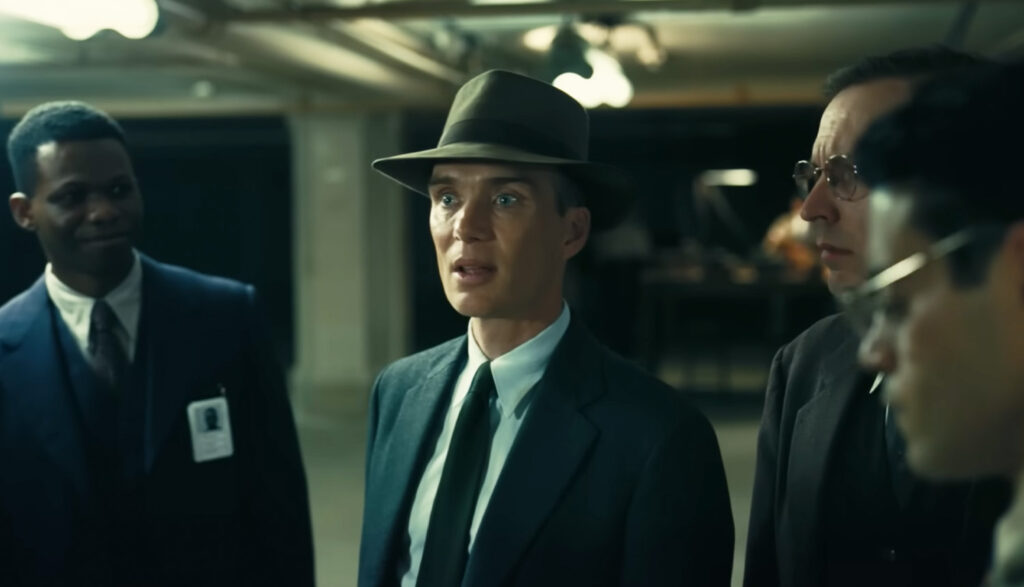
By and large, biopics are a tricky genre to crack. On the one hand, there’s the impossible task of distilling the sum total of a person’s life into a commercially viable 2-hour movie. And on the other hand, you can shoot for the moon with a unique perspective that could alienate audiences and the people associated with the historical figure. With this in mind, Oppenheimer is a scintillating and harrowing historical epic.
The 2023 film is about a young physicist called Robert Oppenheimer (Cillian Murphy) who yearns for quantum physics to be on the research agenda in his native country of America. After the impossible discovery of splitting the atom (aka Nuclear Fission) and the breakout of the Second World War, Oppenheimer is tasked with overseeing the Manhattan Project. The government-funded venture seeks to create the world’s first Atomic Bomb.
Oppenheimer’s greatest trick is that it attempts to dramatise everyday concepts that we almost take for granted. When we hear phrases such as “Nuclear Bomb” or “Mutually assured destruction”, we have a pretty fixed idea of their meaning and purpose as words. However, Nolan takes them and puts them as prominent fixtures in the drama. In the instance of the first, Oppenheimer is depicted almost like a nuclear bomb that’s counting down until it explodes. The ensuing effect is someone who causes great destruction in their personal life, whether it’s the effect he has on his on/off-again lover, Jean Tatlock (Florence Pugh), or an attempt to poison his professor’s apple with cyanide early in the movie.
Part of the movie does examine where Oppenheimer’s loyalties lie, not only to the ideology of Communism (through early affiliations) but also how he feels about the bomb and the implications of its use (after the defeat of the Nazis). This undiscerning depiction of the title character does create a lot of the film’s power as Oppenheimer becomes one with his creation and the effect it brings forth upon the world.
Nolan’s fusing of character and creation reminded me a lot of the depiction of Jim Garrison in Oliver Stone’s 1991 film JFK. At once, he’s a man whose crusade is patriotic and divine (expressed via the heavenly lighting throughout the film) in bringing truth to power via the state’s cover up of Kennedy’s assassination. Oppenheimer’s initial rationale for the creation of the bomb as a tool of retribution for his community and people (the Jews) is as potent as Garrison’s righteous indignation about the state covering up truth and documents that the American people are entitled to view and examine.
At the same time, much of the film’s latter stretch is devoted to fleshing out of the second concept. This comes by way of the use of black and white. Nolan has stated that the scenes in colour represent the subjectivity of the title character’s experiences whilst the use of black and white denote a more objective perspective. Part of the excitement of this section comes from the ensuing political games that Lewis Strauss (Robert Downey Jnr) plays with the committee that’s questioning him. The fallout of which is not only a dramatic illustration of mutually assured destruction but also Nolan’s most subtle use of time. In fact, it’s almost Rashomon esque in showing us the same situation from a different perspective and context. In its own way, it also carries the rip roaring tension of a Cold War thriller in its shifting perspectives to find out who was the instigator of the hearings that the audience is currently watching.
Between his subdued creepy presence as Dr Johnathan Crane/Scarecrow and his supporting turns in Dunkirk and Inception; Cillian Murphy has been a pivotal emotional anchor for various Christopher Nolan films. In Oppenheimer, he takes the spotlight in a commendably delicate performance. This is most apparent in moments where the character is in reflection. The blurred line between intellect and emotion warring for supremacy on Murphy’s face is what makes his central performance so effective. Downey Jnr is also excellent in his supporting performance as Strauss due to the humbleness he displays as a facilitator and defender of Oppenheimer. And Josh Harnett is a fun and pragmatic presence as Oppenheimer’s constant colleague, Ernest Lawrence.
Aside from his depiction of time, Nolan’s direction reinforces how much of a talented horror director he is. This comes from the imagery and sounds he chooses to juxtapose with Oppenheimer’s various moments. These vary from dreamlike scorching atomic imagery to the see-saw of cheers and screams when the character is addressing a room of celebrating colleagues. In the various cutaways that almost stand in for Oppenheimer’s warring mind and conscience, Nolan subverts Terrence Malick-esque imagery to horrific effect. In the same way, his long shots where characters often occupy large empty spaces carry the same uneasiness and isolation that have graced Paul Thomas Anderson films such as The Master.
Ludwig Göransson delivers a surprisingly tranquil and melodic score. The signature instrument at play is the violin, and it’s a pleasure to hear its more reflective and frantic tempos to express the title character’s mind and ambition.
Despite my problems with Oppenheimer, namely Nolan still not getting his female characters quite right (although there’s a sex scene that feels very female gaze in its approach) and a laborious middle stretch, I’ve been surprised by the film. It marks his wittiest screenplay to date, with sardonic dress-downs and black humour being frequent staples. It also addresses the paradigm of biopics with a shifting focus and juggling of genres. Above all, it’s about how history is defined by the collective as opposed to the individual. This matches how Nolan constructed his Batman movies insofar as illustrating the persona as a social construct that’s borne out of a response to a flawed society where the rich are apathetic and the public institutions are corrupt.
In the same way, Oppenheimer depicts the projections and shadows others cast on his character and creation. In turn, Nolan creates a canvas to project our thoughts on Nuclear weapons through the prism of the various players. There’s as much to say about the creation of the bomb as its subsequent uses. And in its best moments, the same could be said about Oppenheimer himself.

 SGS On Film